Reading time: about 12 minutes
Hi, I'm Hiroshi.
For years I had a habit of talking myself out of things. "I could go, but… maybe not." The fear of disappointment felt safer than risking it.
I'd been doing exactly that with Hananomiya Park at Lake Yamanaka for over a decade.
What finally changed? I arrived at the hot spring one hour before it opened. Entirely my own fault. And that accidental hour of free time led me somewhere I should have gone years ago.
This is that story — plus everything you need to know before you visit.
(日本語版はこちら)
Who this post is for
- Motorcycle riders who cruise the Doshu Road toward Lake Yamanaka
- Anyone who has heard of Hananomiya Park but never quite made it there
- People planning a half-day combining flowers and an onsen near Lake Yamanaka
- Anyone wondering whether the ¥600 (approx. $4) paid admission is worth it
- People who enjoy reading about a middle-aged man scaring himself alone in an underground lava cave
The short answer
"Maybe I'll skip it" is almost always the wrong call.
The waterfall sounded exactly like a real waterfall should. The triple waterwheel was exactly as impressive as its name implies. The lava cave underground was significantly scarier than it looks on video. And the ¥600 (approx. $4) admission was absolutely worth it.
An accidental failure — arriving at the hot spring an hour early — led me to a park I'd skipped for ten years. The days that don't go to plan are the ones I remember most.
Table of Contents
- The luxury of thinking about nothing on the Doshu Road
- Arriving at the hot spring one hour early
- Everything you need to know about Hananomiya Park [Complete Guide]
- The day I finally entered the park I'd skipped for ten years
- Why I stopped walking in the free zone
- What I thought while pulling out my wallet — and what I thought after
- The triple waterwheel made me say "oh" out loud, alone
- Floral Dome Furara: a different climate inside a mountain
- Standing in front of Myojin Falls, thinking nothing at all
- In the lava cave, I quietly asked myself if I was okay
- The perfect half-day plan [with timetable]
- Final thoughts: The days that don't go to plan
The luxury of thinking about nothing on the Doshu Road
It was a weekday morning. I had nowhere in particular to be.
After a bowl of ramen, I got on my bike and headed for the Doshu Road — one of Japan's most scenic mountain routes in Kanagawa and Yamanashi prefectures.
The Doshu Road doesn't need a destination. Cold mountain air, one curve after another, the light filtering through the trees. Twist the throttle and your head empties out.
In my twenties, riding was about getting somewhere. In my fifties, the ride itself is the point. No hurry. No reason to rush. That's the quiet luxury of a weekday on a motorcycle.
Before I knew it, I was near Lake Yamanaka.
Arriving at the hot spring one hour early
"I'm already here — might as well soak in the hot spring before heading home."
I rode to Beniuji no Yu, the hot spring near Lake Yamanaka.
I arrived. Turned off the engine. Read the sign.
"Open from 11:00 on weekdays."
I checked my phone. 10:00.
……
Nobody's fault but mine. A five-second Google Maps check would have told me this. I just didn't check.
I sat on my bike for a minute, doing nothing. "What now," I asked myself. Nobody in the parking lot answered.
I started the engine and rode around. That's when I spotted a sign: "Yamanakako Hananomiya Park."
Everything you need to know about Hananomiya Park [Complete Guide]
Information first, so you don't make my mistake of showing up without checking.
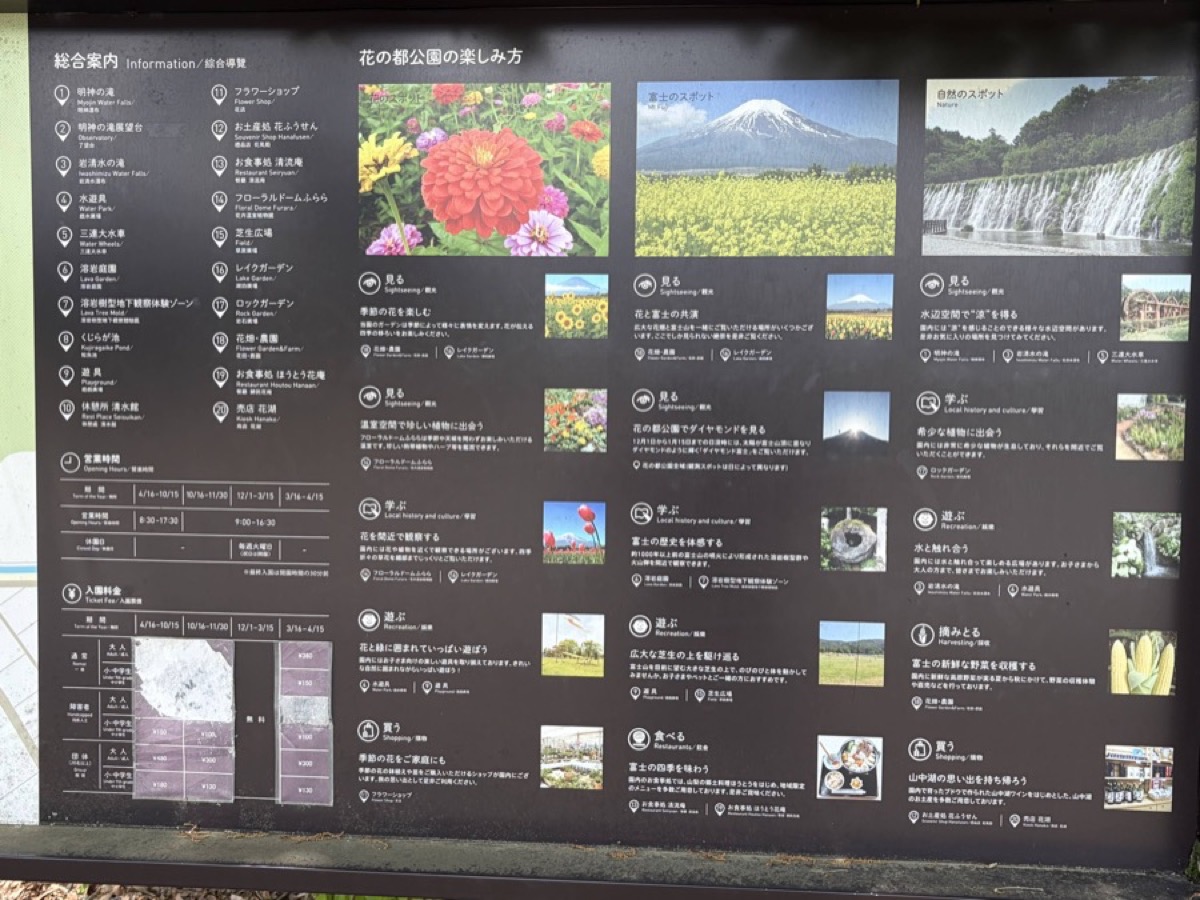
Basic facts
| Item | Details |
|---|---|
| Official name | Yamanakako Hananomiya Park (山中湖花の都公園) |
| Address | Yamanaka 1650, Yamanakako Village, Minamitsuru District, Yamanashi |
| Phone | 0555-62-5587 |
| Elevation | approx. 1,000m (can feel 10°C cooler than lowland areas) |
| Area | approx. 300,000 m² |
| Established | Around 1994 (30+ years of history) |
Opening hours and closed days
| Period | Hours |
|---|---|
| April 16 – October 15 | 8:30 – 17:30 |
| October 16 – April 15 | 9:00 – 16:30 |
| Last admission | 30 minutes before closing |
| Winter closures | Every Tuesday, December 1 – March 15 (except year-end/New Year) |
Admission fees
| Zone | Adults | Junior/Middle School | Notes |
|---|---|---|---|
| Flower fields & farm (free zone) | Free | Free | Always accessible |
| Seiryu no Sato & Floral Dome Furara (paid zone) | ¥600 (approx. $4) | ¥240 (approx. $1.60) | Free Dec 1 – Mar 15 |
| Under elementary school age | Free | — | — |
Parking: Passenger cars ¥300 (approx. $2), buses ¥1,000 (approx. $6.67). Around 220 spaces. On weekday mornings, plenty of room.
What's in bloom in May
| Flower | Bloom season |
|---|---|
| Tulips | Late season (through early May) |
| Nemophila | Early May – mid-June (peak) |
| Wisteria | Mid-May in 2026 (confirmed in bloom) |
The Mount Fuji question — the single biggest factor in visitor satisfaction
Reviews repeatedly mention "the flowers were beautiful, but it was a shame we couldn't see Fuji." Equally, there are rave reviews saying "Nemophila with Fuji in the background was breathtaking."
- Right after opening (8:30 onward) is when the air is clearest
- June, September, and October tend to have higher rainfall and more cloud cover
- Check the Lake Yamanaka Tourism Association's Fuji live camera the morning of your visit
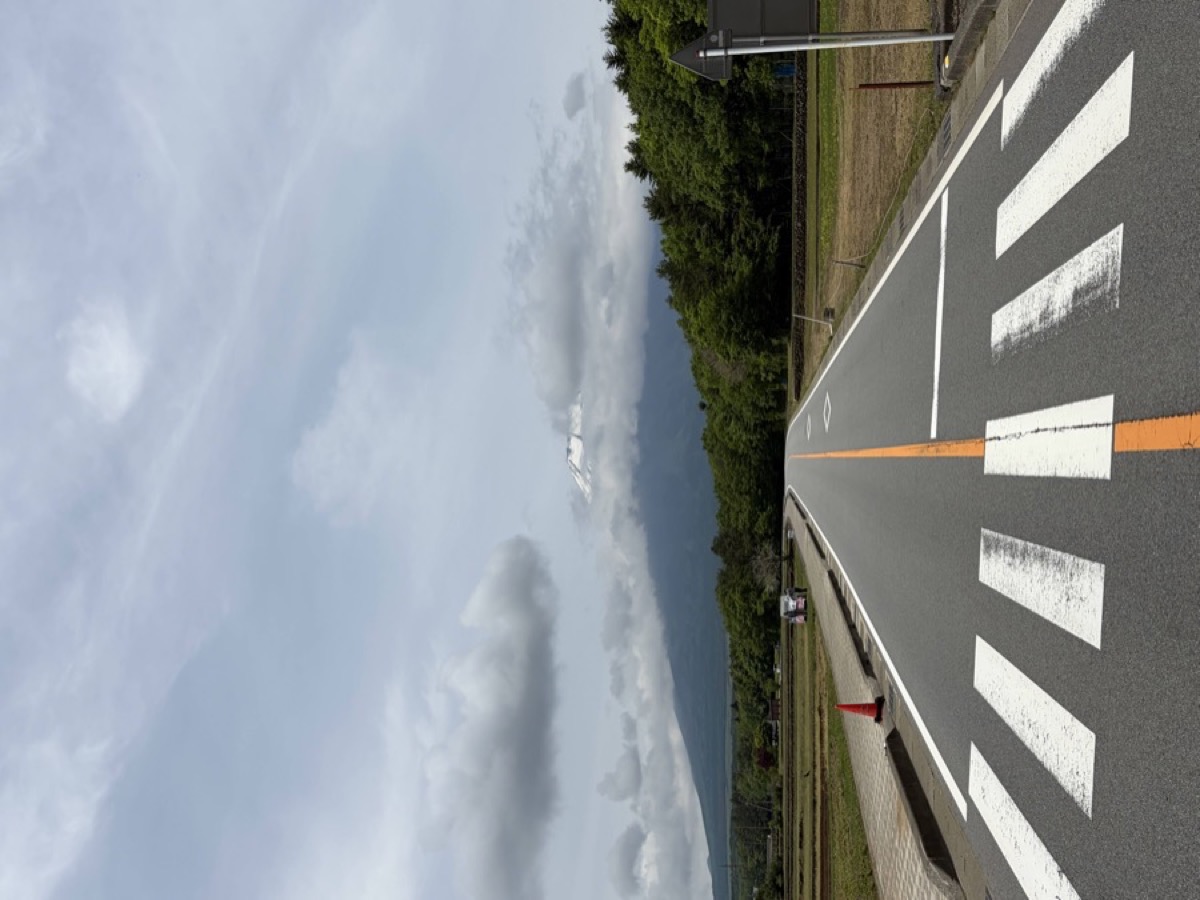
"Flowers plus Fuji" makes this park worth 1.5x as much as "flowers alone." Knowing this before you go changes how you plan your morning.
What's included in the ¥600 (approx. $4) paid zone
- Triple Waterwheel
- Myojin Falls
- Iwashimizu Falls
- Floral Dome Furara (all-weather greenhouse)
- Lava Tree Mold Underground Observation Zone
- Water play area (summer only)
Six attractions for ¥600 (approx. $4). Worth it. I'll explain with my body later.
⚠️ 2026 facility closure notice (important)
Myojin Falls, the Triple Waterwheel, and water play facilities in Seiryu no Sato will be closed for maintenance from June 22 to June 30, 2026. Water play facilities also have a separate planned closure from November 9, 2026 through late March 2027. Check the official website before visiting after late June.
The day I finally entered the park I'd skipped for ten years
I'd known this park existed for years. Every time I rode through the area, I saw the signs. Every time I thought "maybe next time" and kept going.
For over a decade.
The reason my decade-long streak of skipping it finally ended was that I arrived at a hot spring one hour too early. Not exactly a heroic motivation — but that's the truth.
I paid ¥300 (approx. $2) for parking and walked toward the entrance.
Why I stopped walking in the free zone
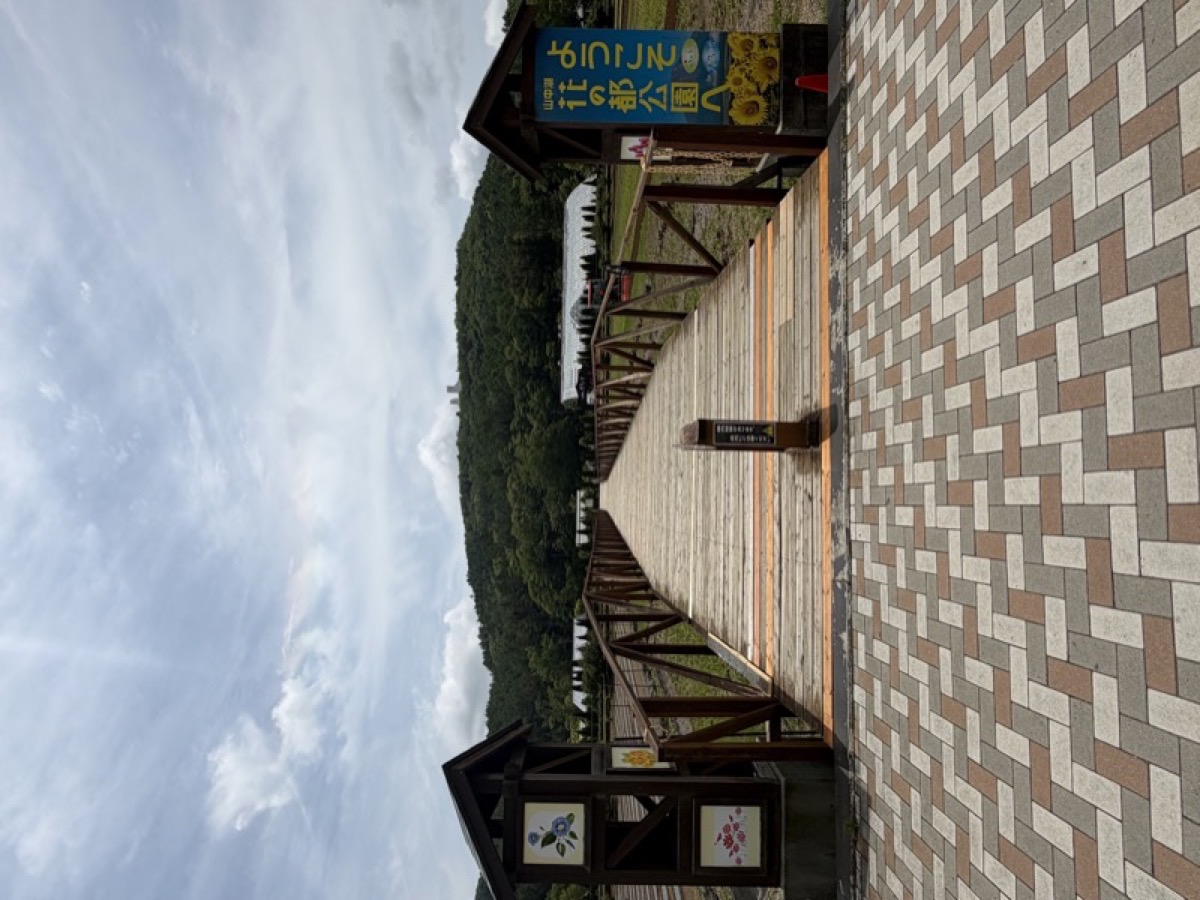
There's a small wooden bridge at the entrance, with a blue sign: "Welcome to Hananomiya Park."
The moment I crossed it, the road noise disappeared. In its place: a faint sound of running water somewhere in the distance.
"Okay. This is a real place."
That was my honest first impression.
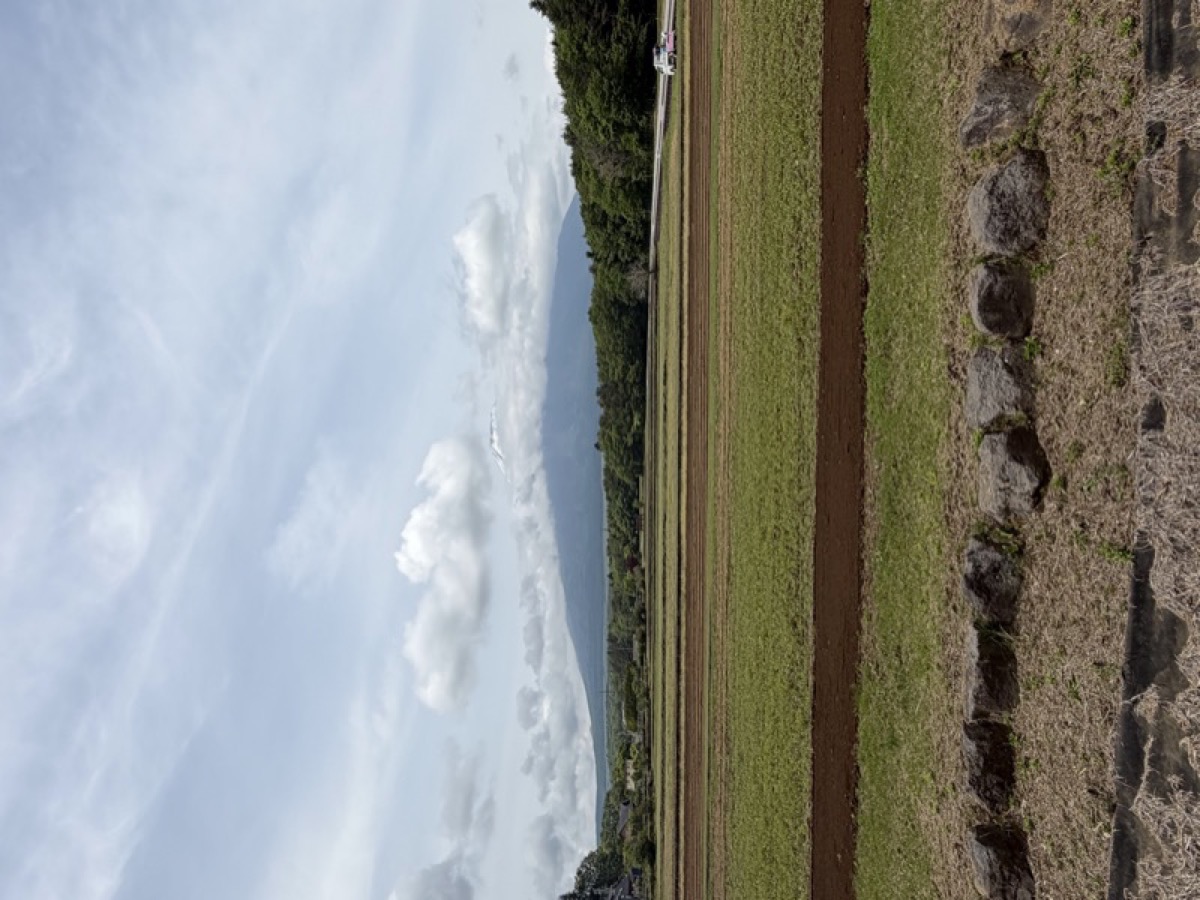
Past the entrance bridge, the farmland opened up. Mount Fuji was visible through a gap in the clouds — just the outline, the silhouette.
That was enough.
📷 Photo tip: Mount Fuji is visible from the farmland area near the entrance. Fuji tends to cloud over as the morning goes on — check early.
What I thought while pulling out my wallet — and what I thought after
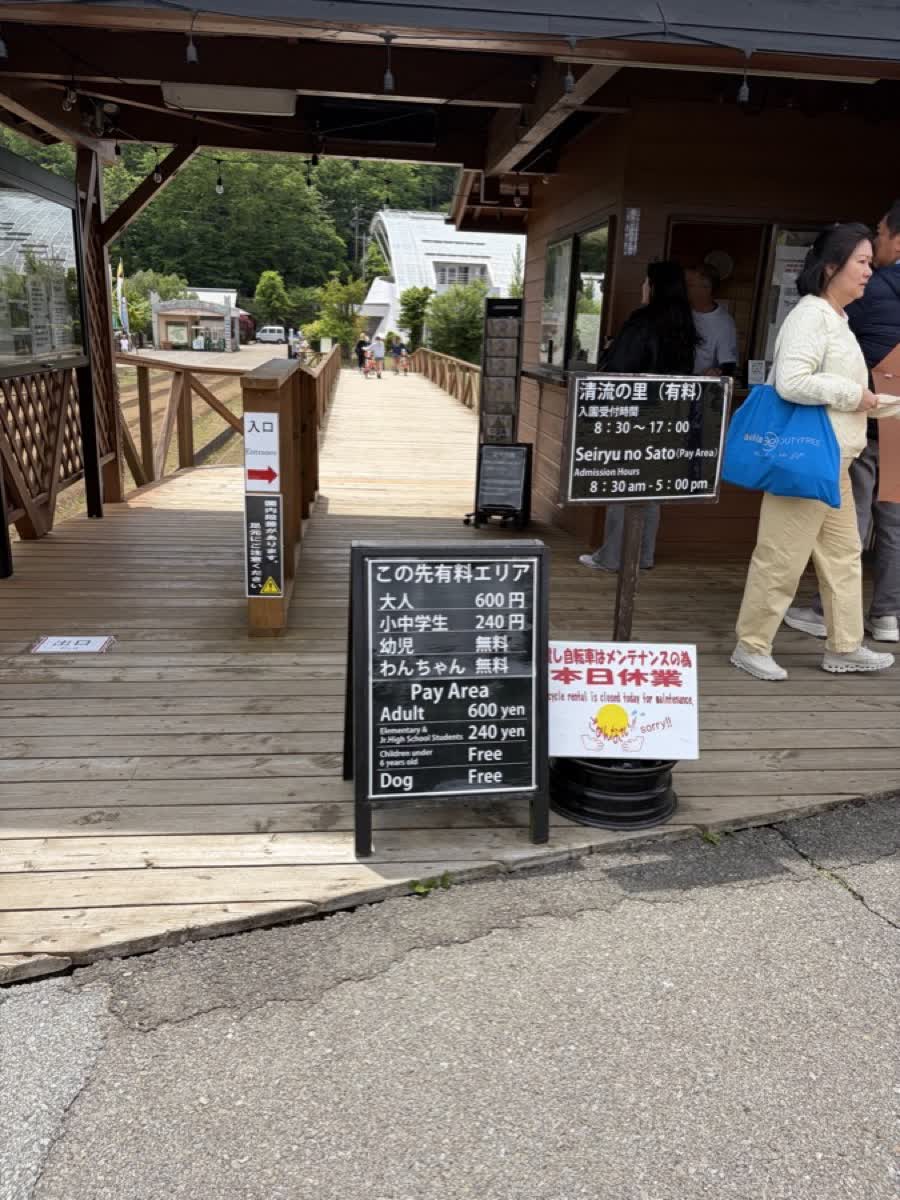
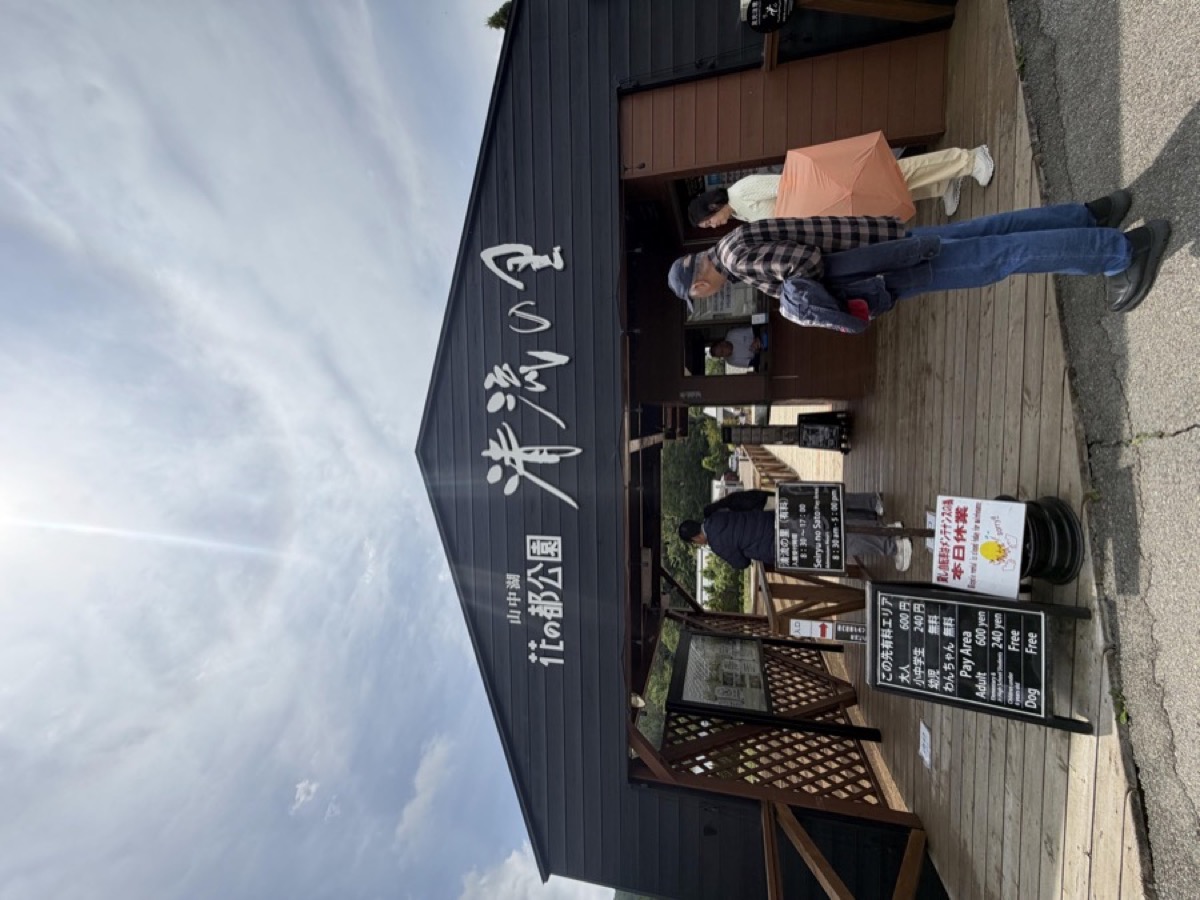
I paused at the entrance sign. "Seiryu no Sato & Floral Dome Furara — Adults ¥600 (approx. $4)."
Reaching for my wallet, I thought: "¥600 (approx. $4) for what was supposed to be killing time…"
I paid. "That was the right call." That's what I thought after.
Skipping the paid zone means skipping the Triple Waterwheel, Myojin Falls, the Floral Dome, and the lava cave. Everything that comes next in this article. That's too much to leave on the table.
The first thing I noticed entering the paid zone was the flower fields.
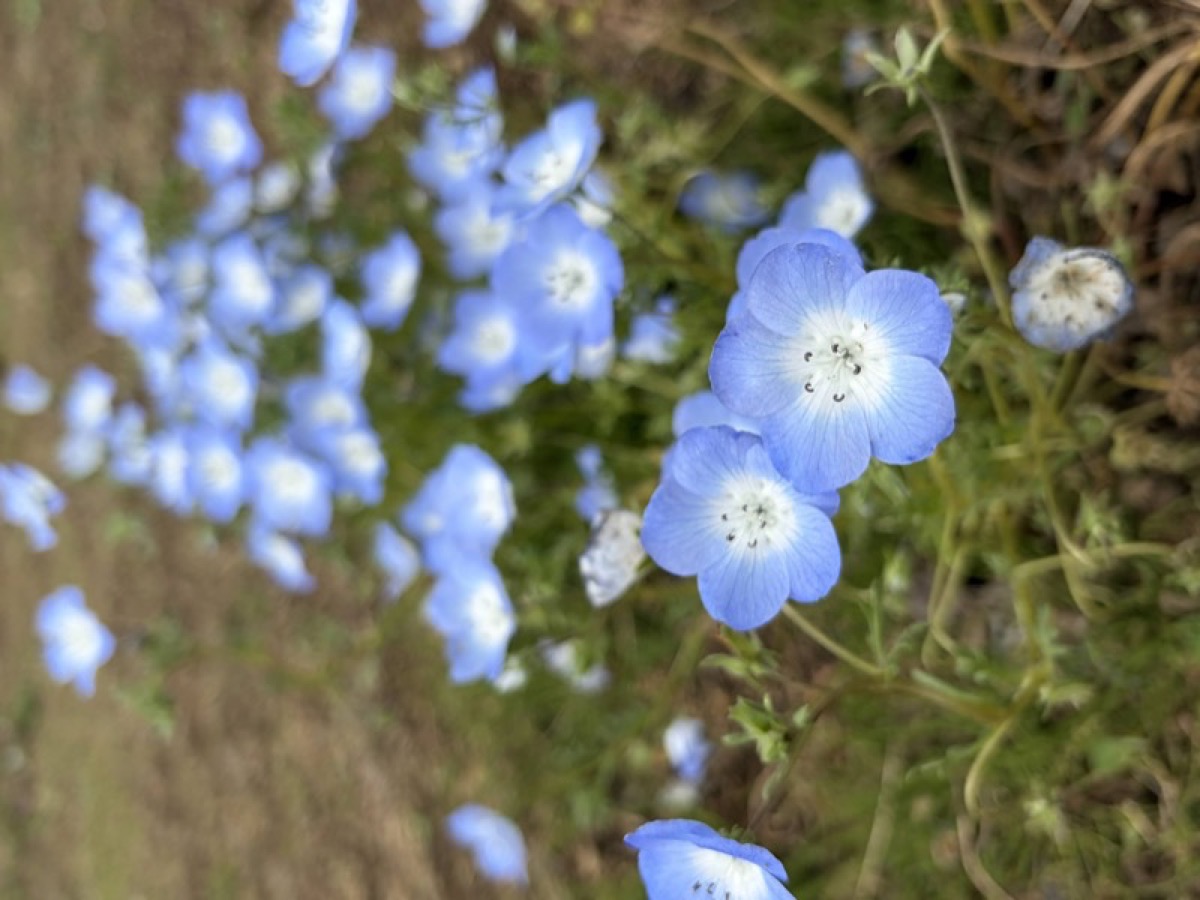
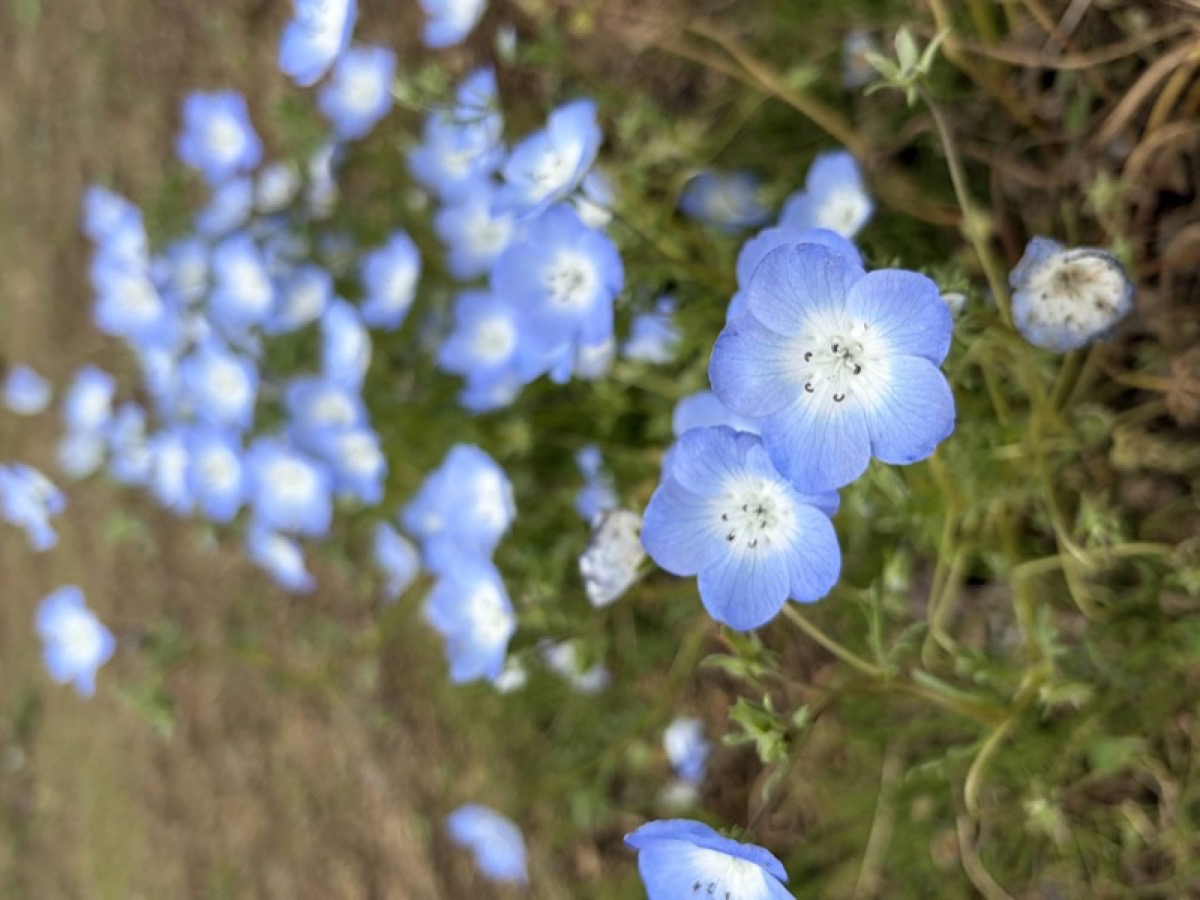
Nemophila — masses of small blue-purple flowers across the ground. One flower is easy to overlook. Together, they produce a color that blurs into the sky.
I crouched down to look closely. Five petals, detailed markings at the center.
Twenty-year-old me never would have crouched to look at a flower. Somewhere in my fifties, I started being able to actually see small things.
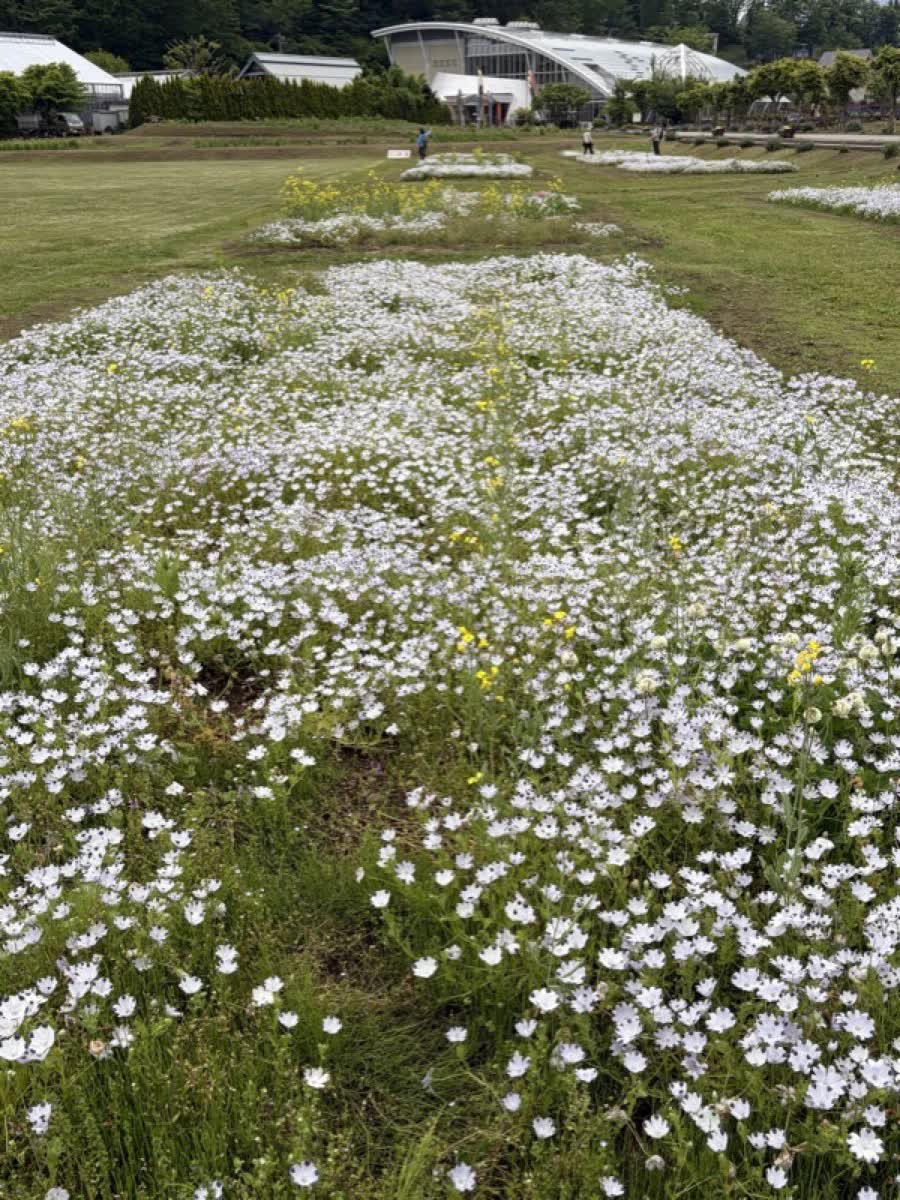
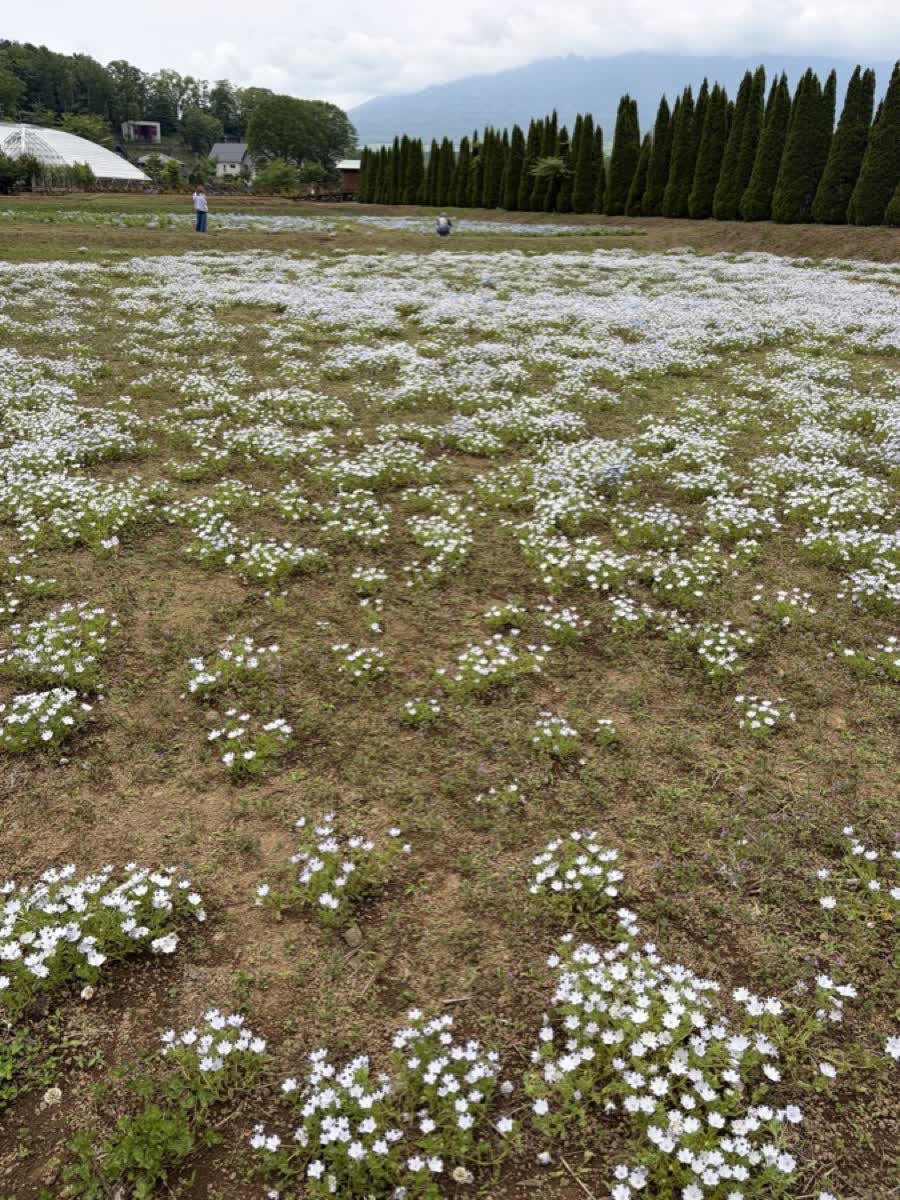
📷 Photo tip: Right after entering the paid zone, you can shoot nemophila with Fuji in the background. Crouch down, put nemophila in the foreground. Fuji tends to cloud over as the morning goes on — shoot this early.
The triple waterwheel made me say "oh" out loud, alone
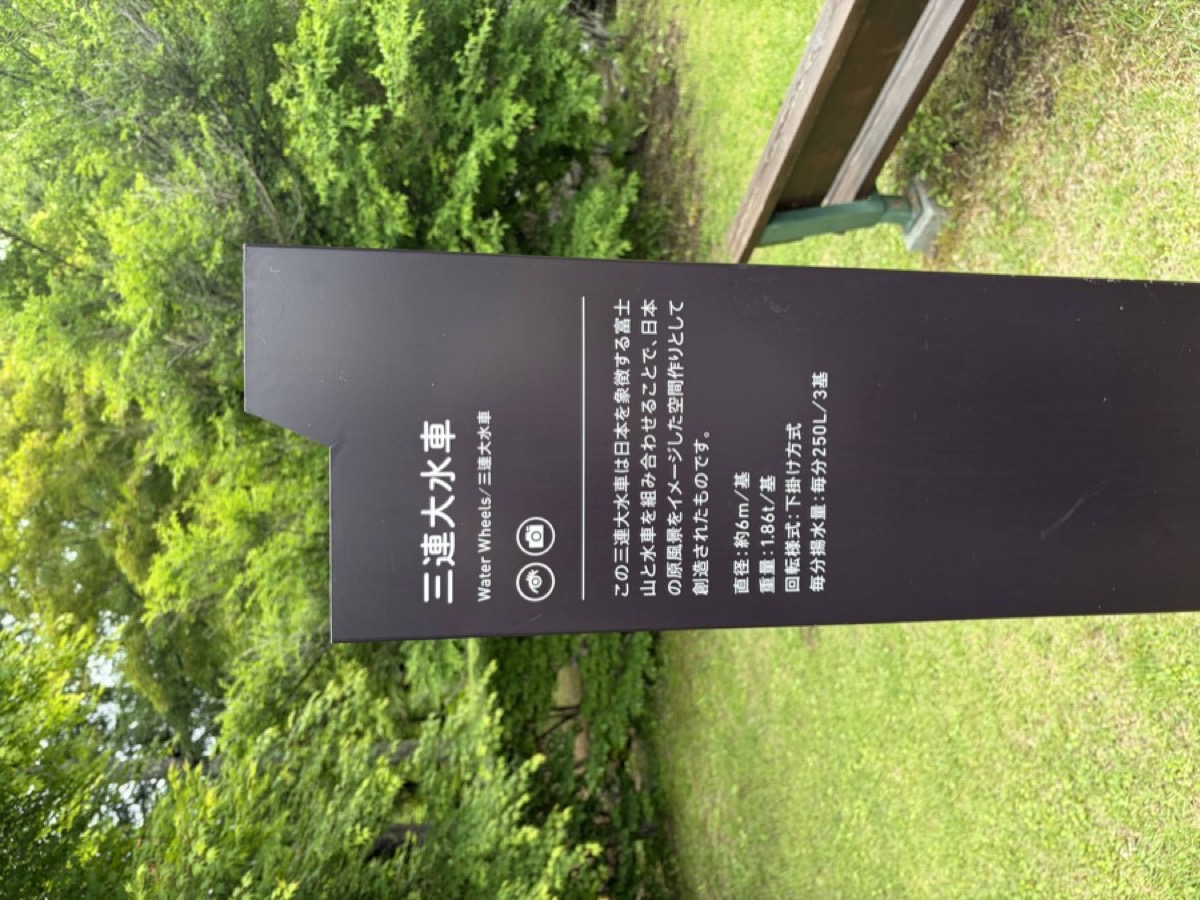
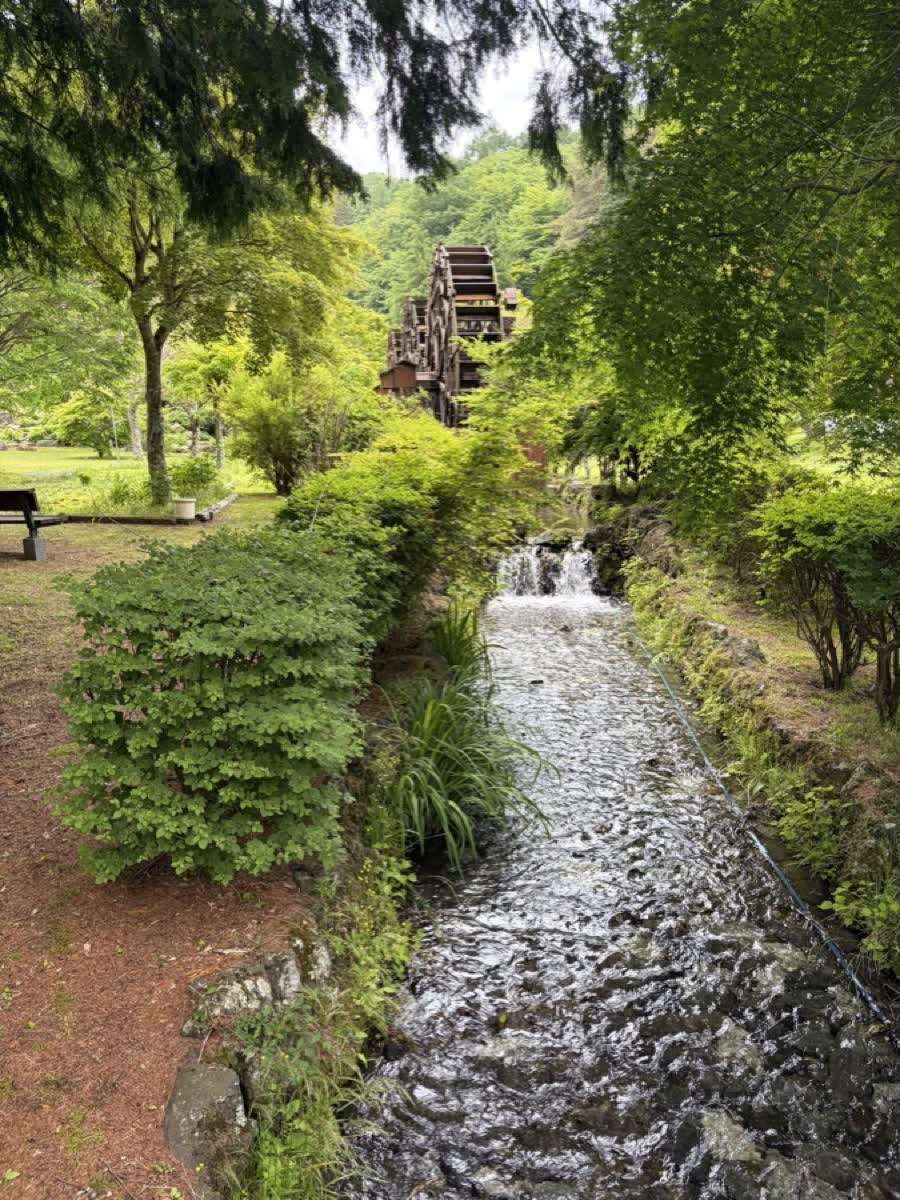
The first thing I saw entering the paid zone was the Triple Waterwheel. I walked toward it thinking "waterwheel, sure." Low expectations.
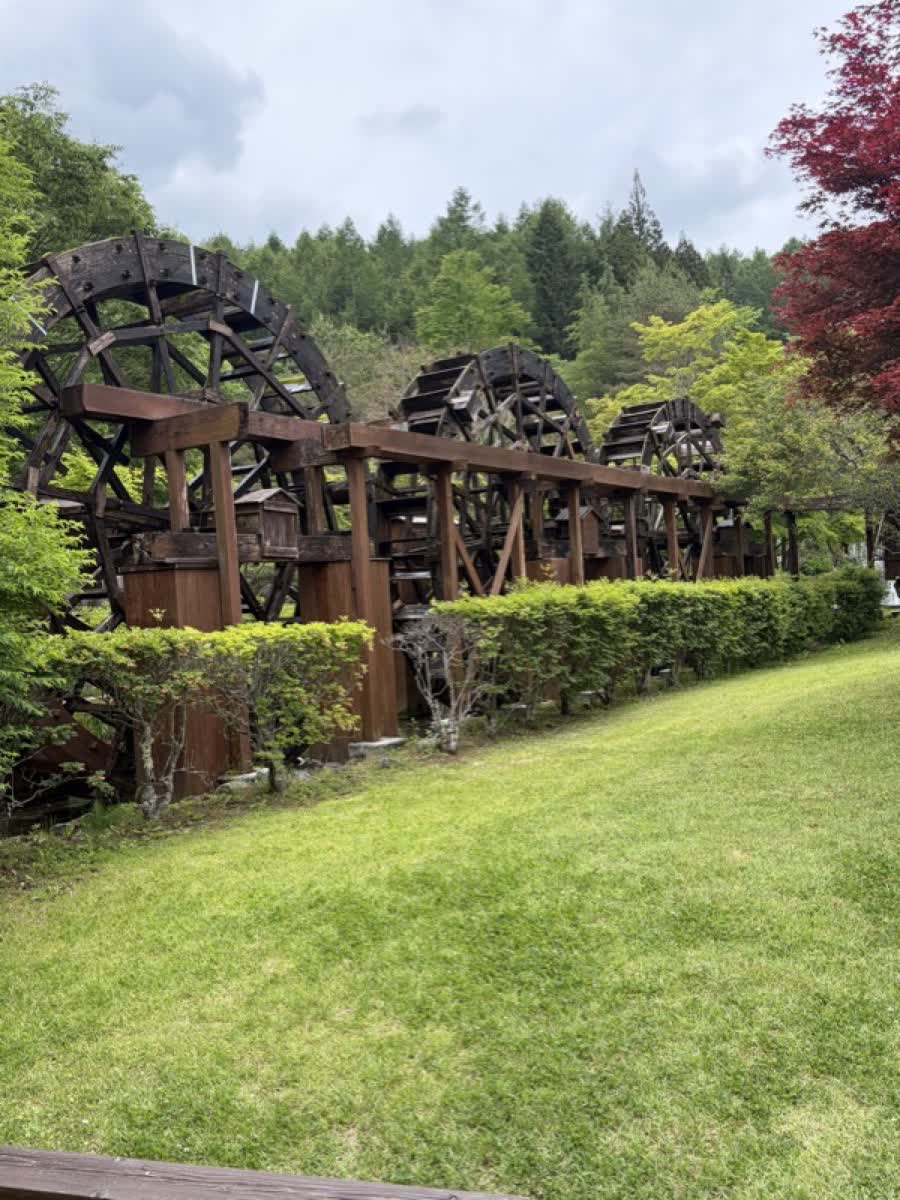
I saw it. They were big.
Three large wooden wheels, side by side. All of them turning. Scooping water, letting it fall, going around again. The sound of the water hitting the surface below.
"Oh," I said out loud. Nobody around to hear it. Weekday morning.
Nobody there — and I still made a sound involuntarily. That's how much it exceeded my expectations. The name "Triple Waterwheel" is exactly what it is. Three wheels. Enormous. Turning. No exaggeration in the name at all.
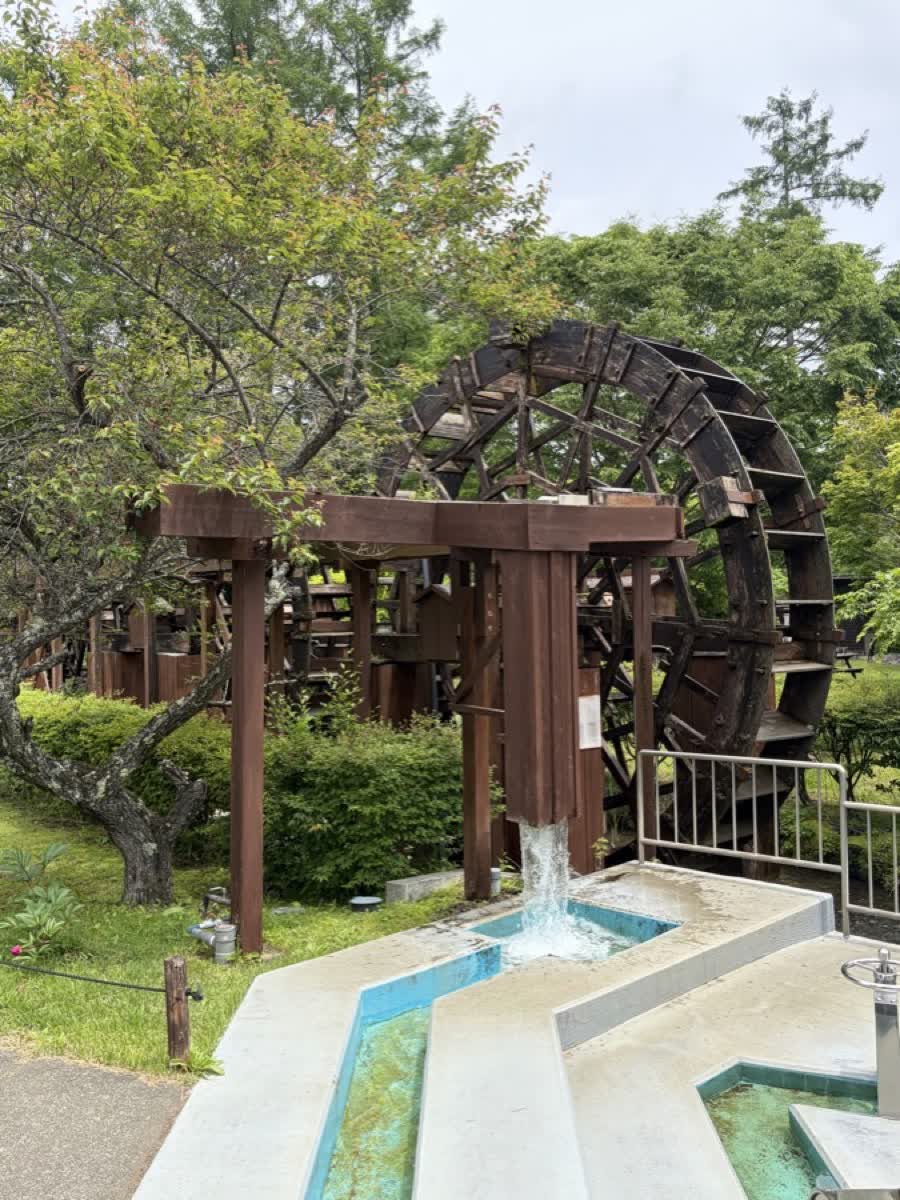
📺 Watch it move in the video below.
📷 Photo tip: Step back far enough to fit all three wheels in frame. Get too close and you lose the "triple" effect.
Floral Dome Furara: a different climate inside a mountain
I entered the all-weather greenhouse, Floral Dome Furara.
The moment I stepped inside, the air changed. It was warm. Outside was 1,000m elevation in May — cool enough to want a jacket. Inside was humid, warm, and sweet-smelling. The dense sweetness of tropical flowers.
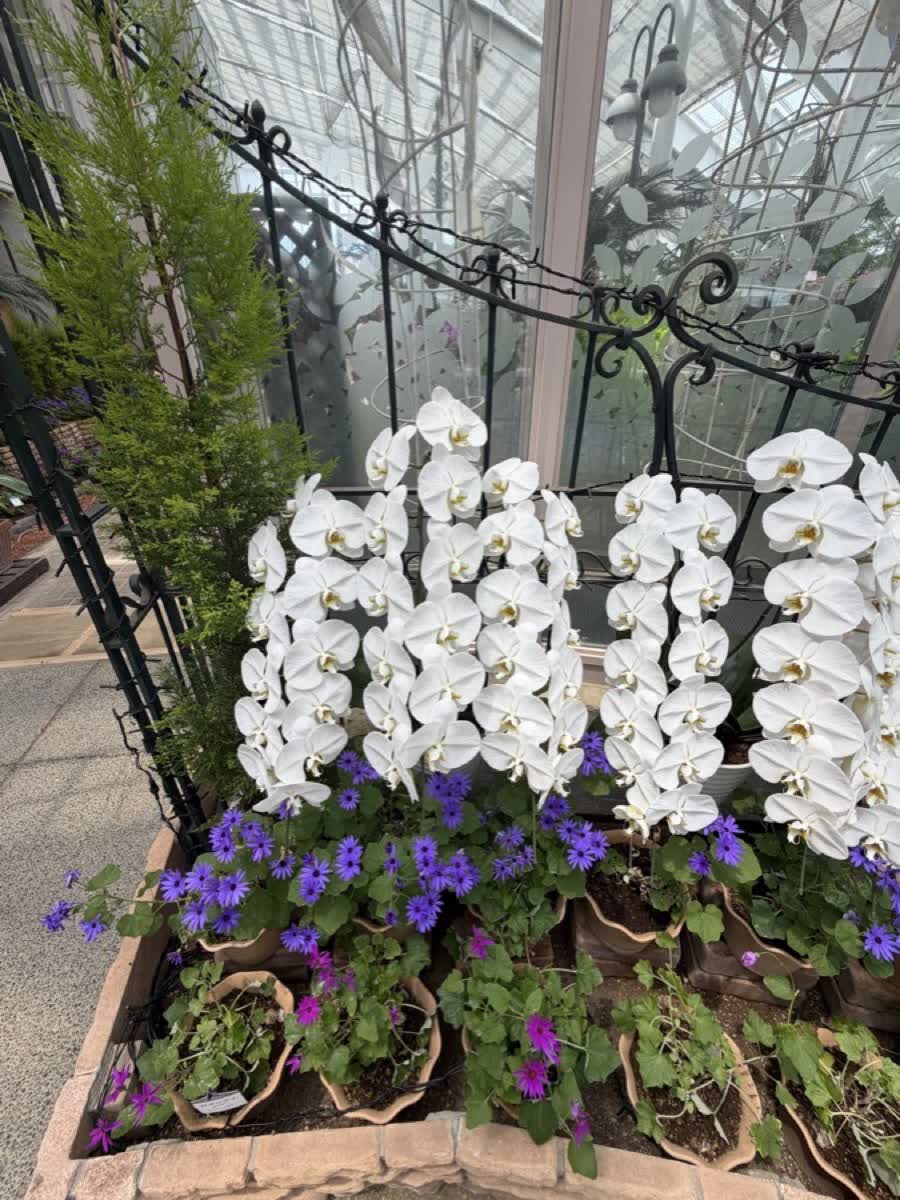
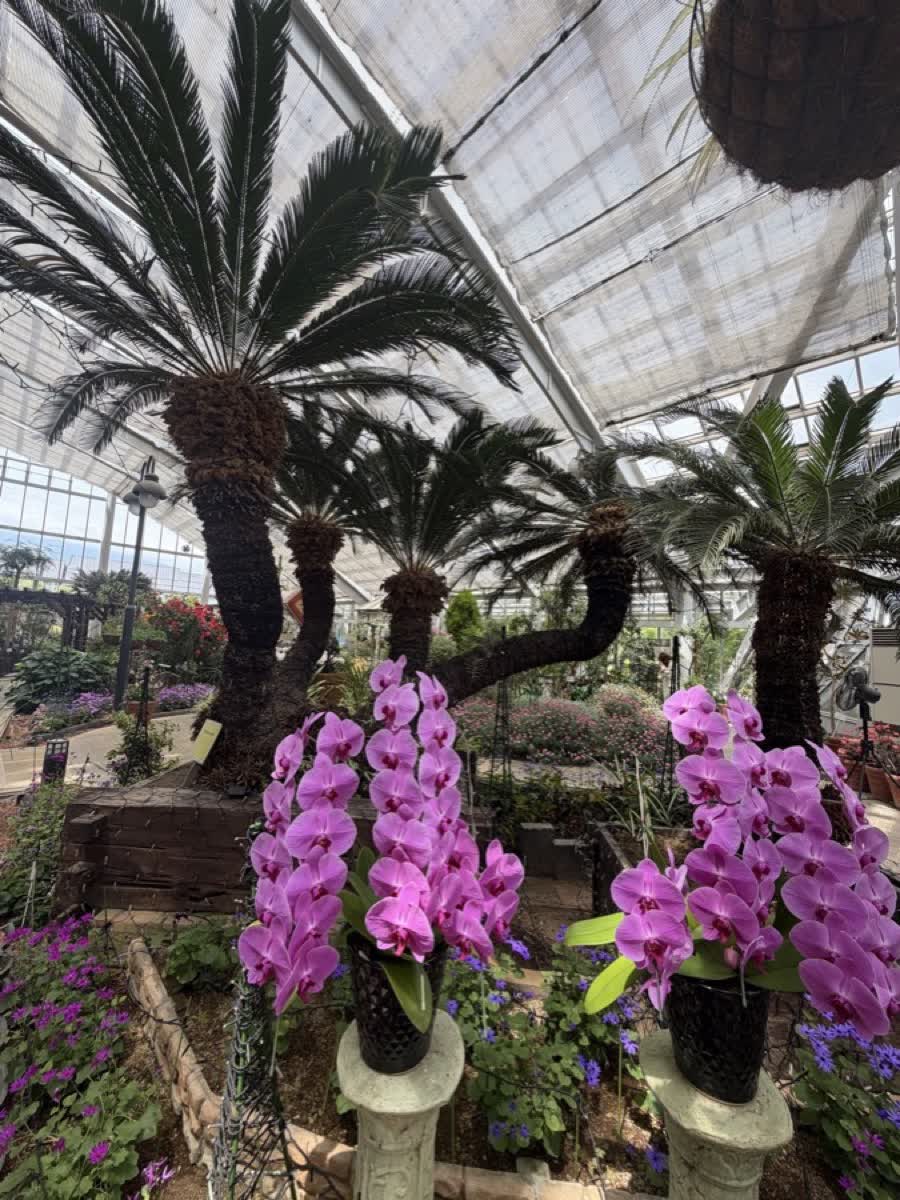
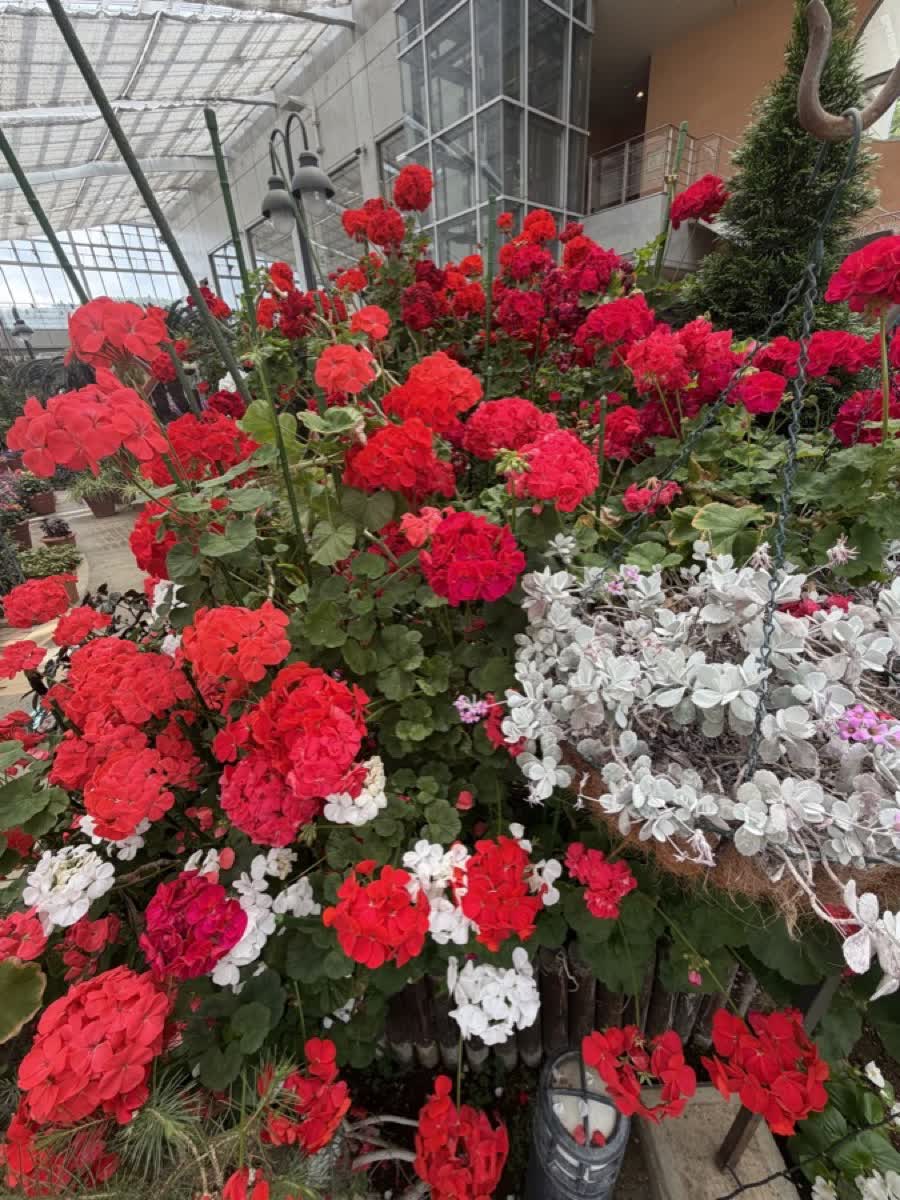
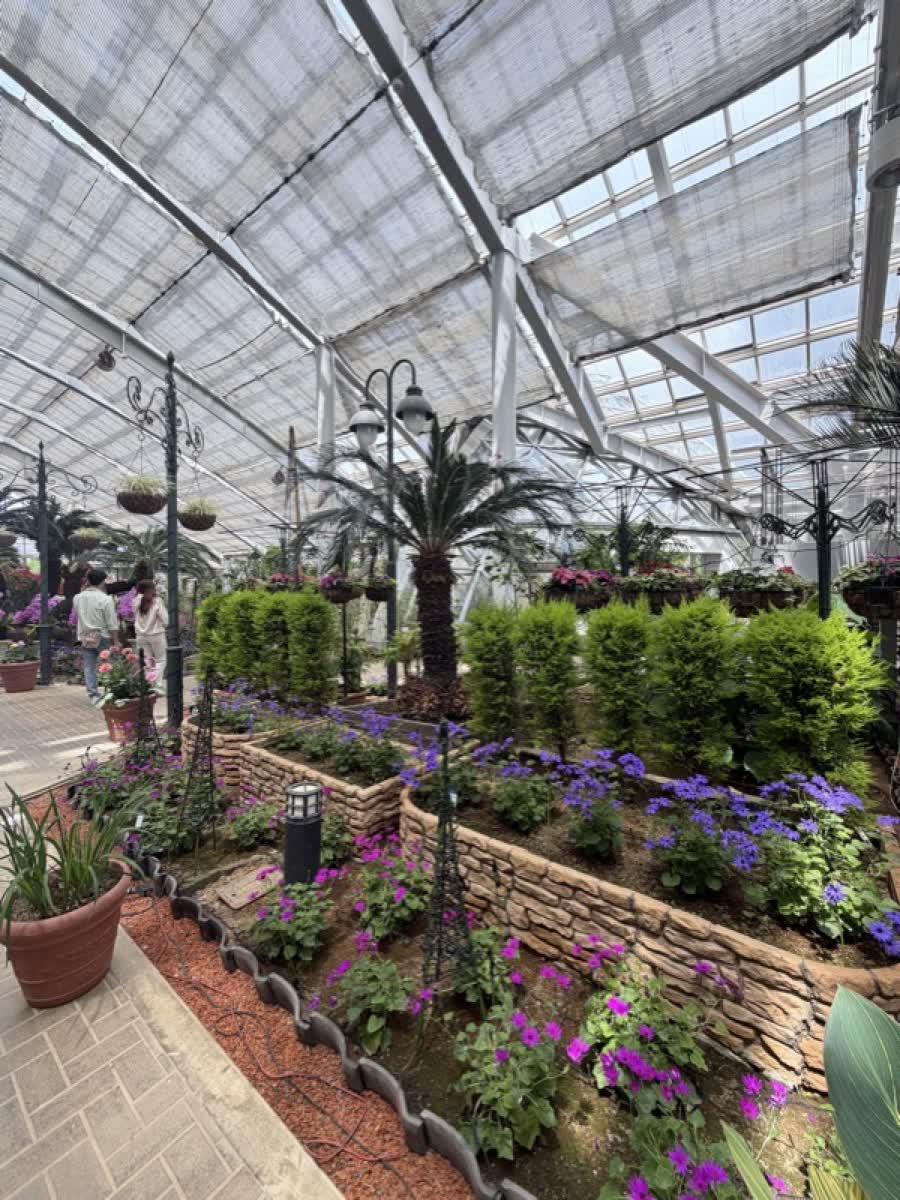
"Why does a mountain in Yamanashi have a tropical greenhouse?" The incongruity of it was part of the charm.
Rain or clouds outside: irrelevant. In here, you're somewhere else entirely. This is one of the most reliable "weather-proof" spots I know.
Standing in front of Myojin Falls, thinking nothing at all
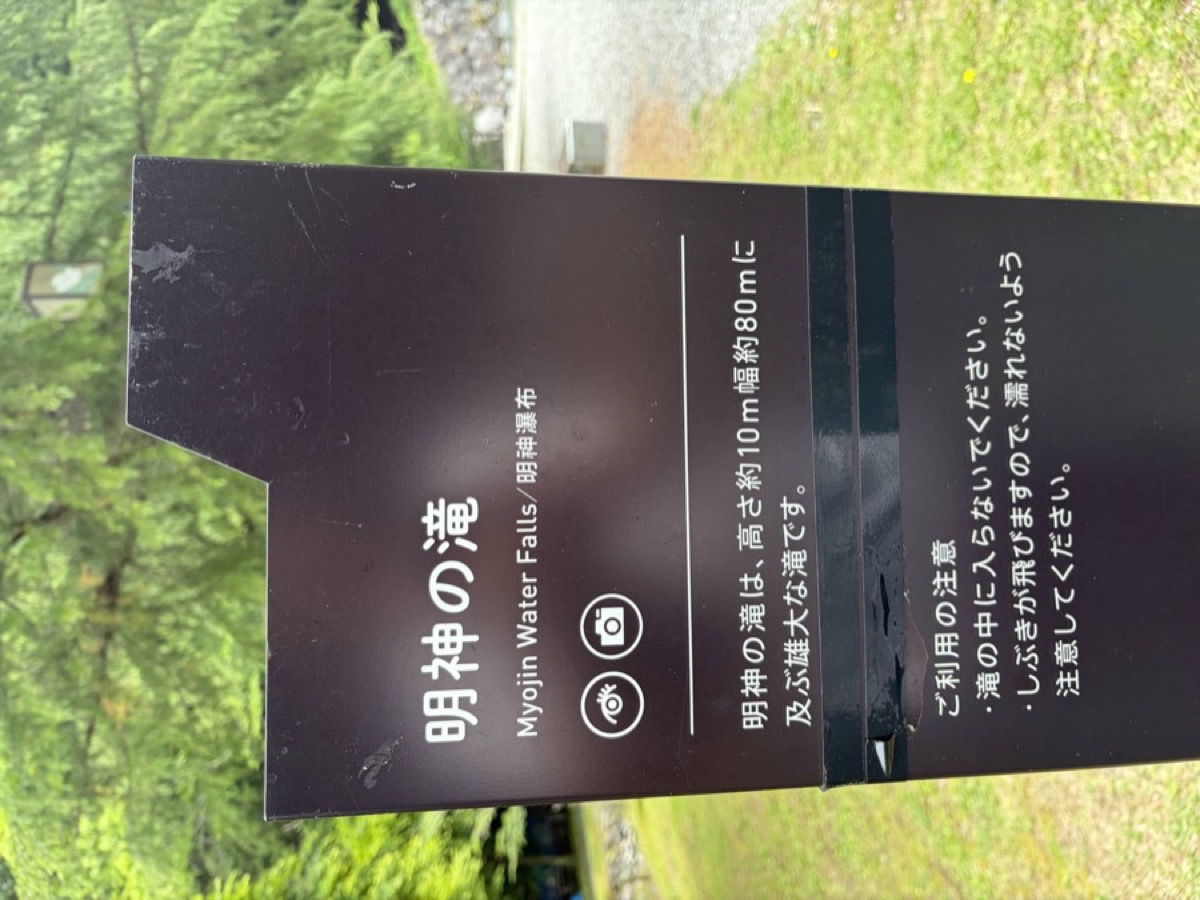
Of everything in the paid zone, Myojin Falls was the highlight.
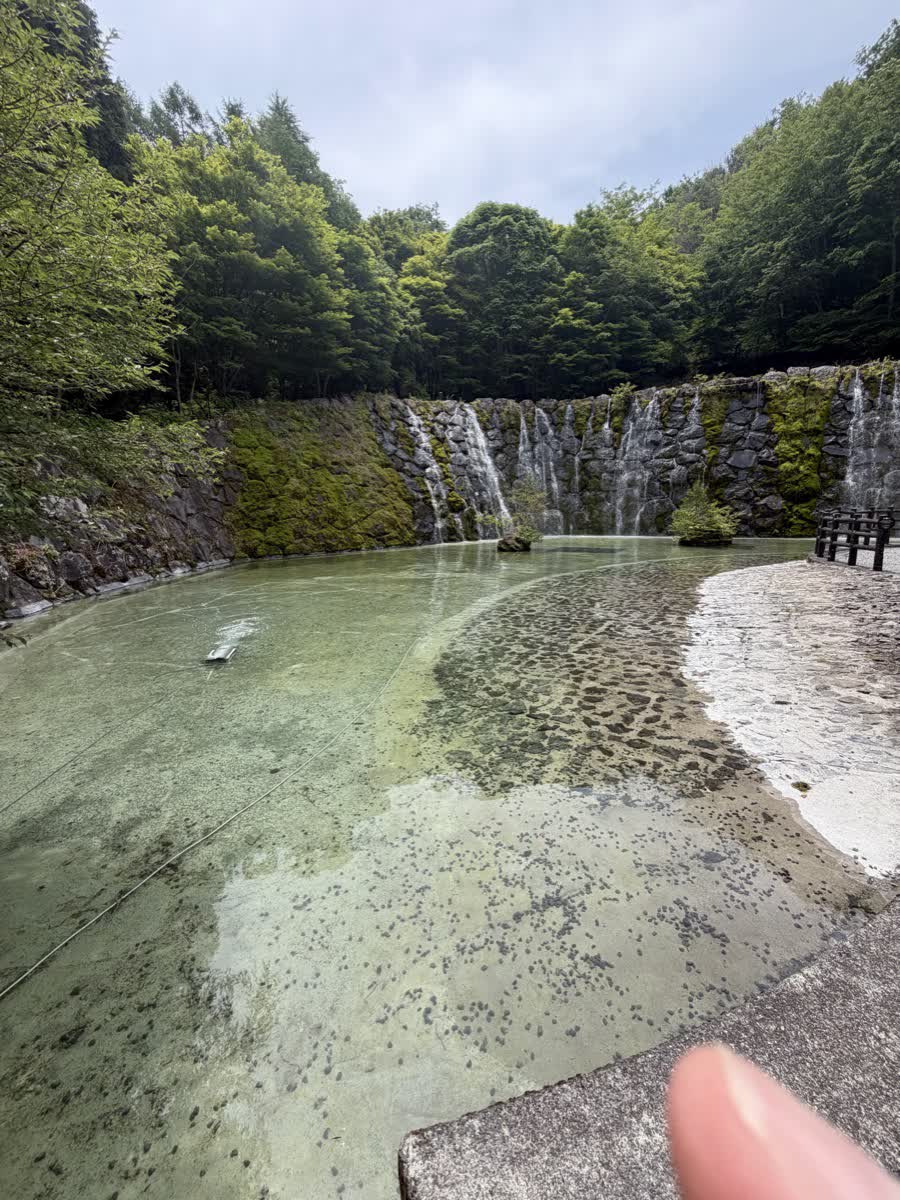
It was wider than I'd imagined.
Multiple streams of white water fell down a broad rock face. The pool at the bottom was a pale green, the rock pattern visible through the water. Only the sound of water.
Not a rush or a roar — surprisingly quiet for something that wide. Clear and steady.
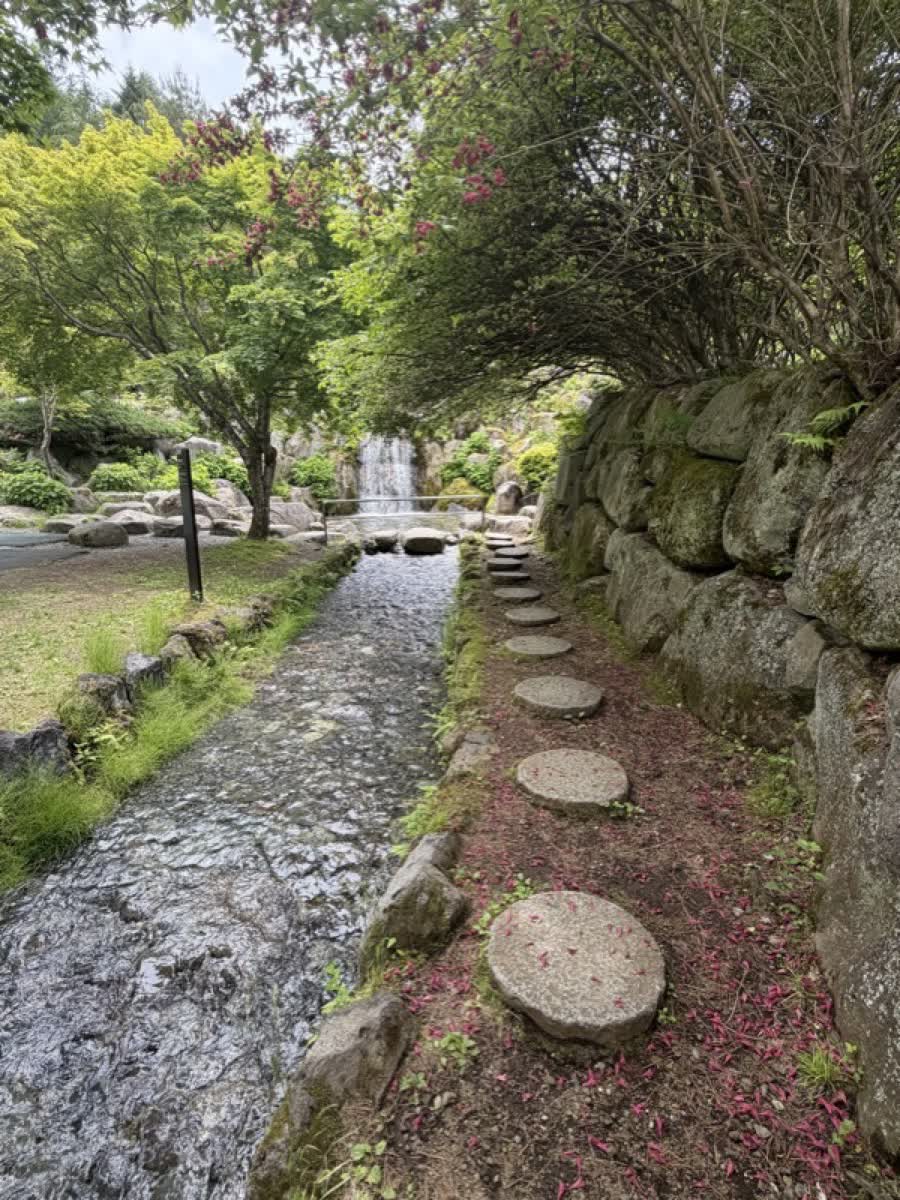
I stood there for a while. Thinking nothing at all.
The only two times today I stopped thinking were: while riding the Doshu Road, and while standing in front of this waterfall. That was the real luxury of the day.
Twenty-year-old me would have been grabbing more photos. Thirty-year-old me would have been planning the next stop. Fifty-year-old me just stood there, listening to the water. That was enough.
📺 Myojin Falls on video:
📺 Falls area overview:
📷 Photo tip: Shoot from a slight angle to get the moss-covered rock face and water in the same frame. Head-on gives you just the water. The texture of the moss makes the scene.
In the lava cave, I quietly asked myself if I was okay
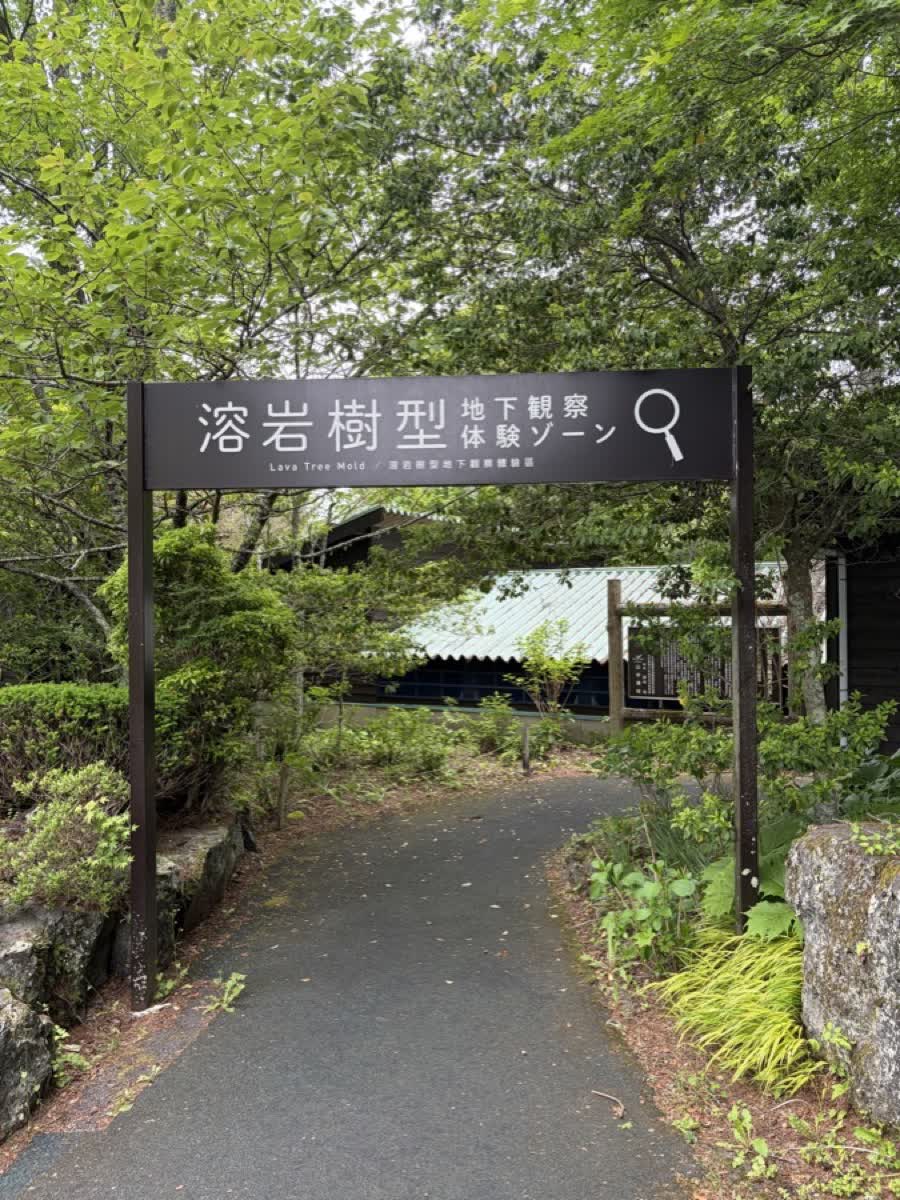
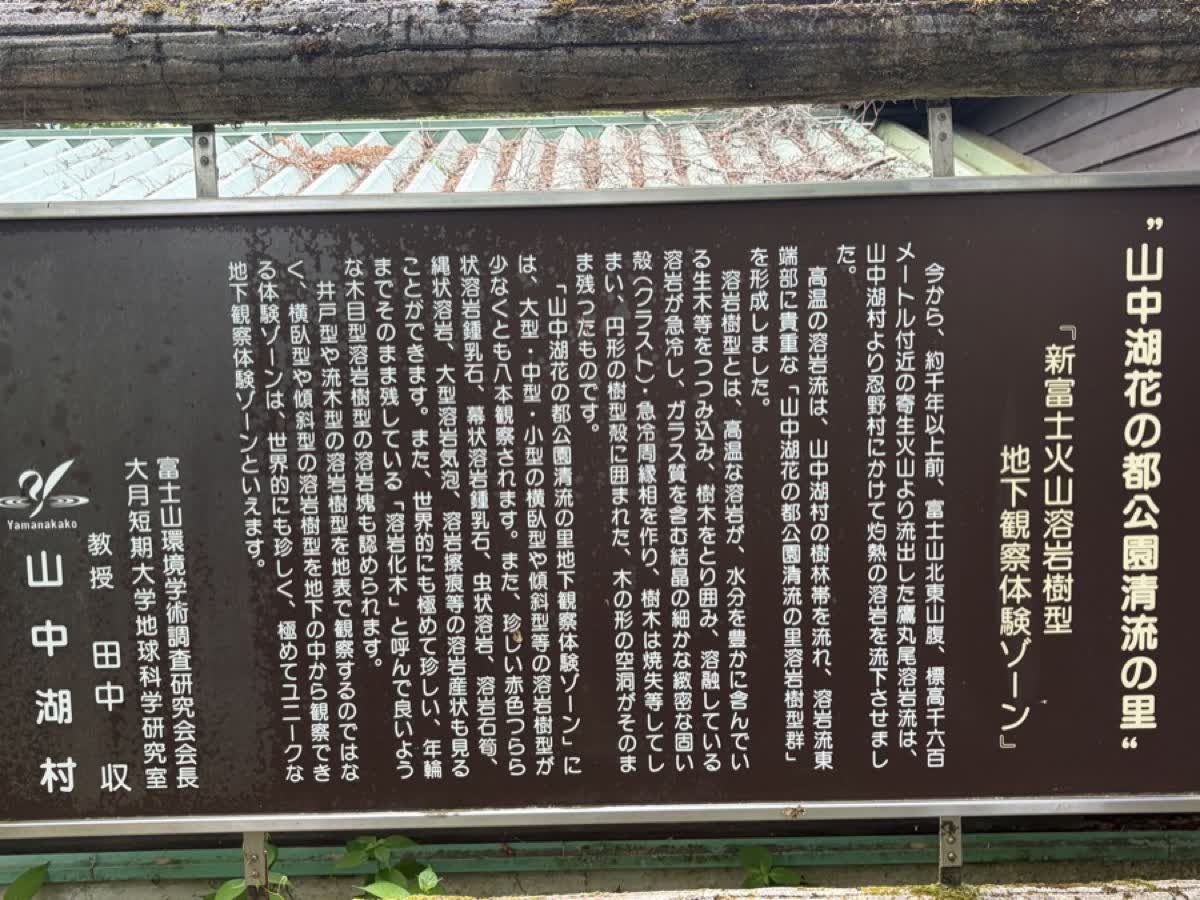
The Lava Tree Mold Underground Observation Zone. When Mount Fuji erupted, lava encased the trees. The trees burned away, leaving cylindrical tunnels underground. Those are lava tree molds.
"That sounds interesting." I walked in alone. This was my mistake.
Three steps inside the entrance. Dark. Five steps. Darker. A chill rising from the floor. The sound — completely different from outside. Completely still. Cold enough that my breath almost showed.
I took out my phone and started filming. On screen, everything looked surprisingly bright. But with my own eyes: dim. "Why does it look so much lighter on video?"
I kept going. Kept getting a little more unsettled.
Nobody here. No sound. Cold. Dark. A man in his fifties, alone in an underground lava cave.
Then, out of nowhere, a thought: "Wait, is it okay to film in here?" Probably fine. But "probably" wasn't good enough anymore. I wanted to check with someone. Nobody was there.
I caught myself whispering: "Am I okay?"
To myself. Nobody heard. The rock walls reflected it slightly. That made it worse.
I turned around. Fast-walked to the exit. Stepped out into the daylight and felt genuinely relieved. By myself. Relieved, by myself.
📺 The lava cave on video:
Watch that video. It probably looks fine — even kind of cool. In person, it is darker, colder, quieter, and scarier than it appears on screen.
Go in knowing that, and it becomes an interesting experience. Go in blind, alone, and you might end up whispering to yourself in the dark. If possible, don't go in alone. Two people: funny story. One person: possible horror experience.
The perfect half-day plan [with timetable]
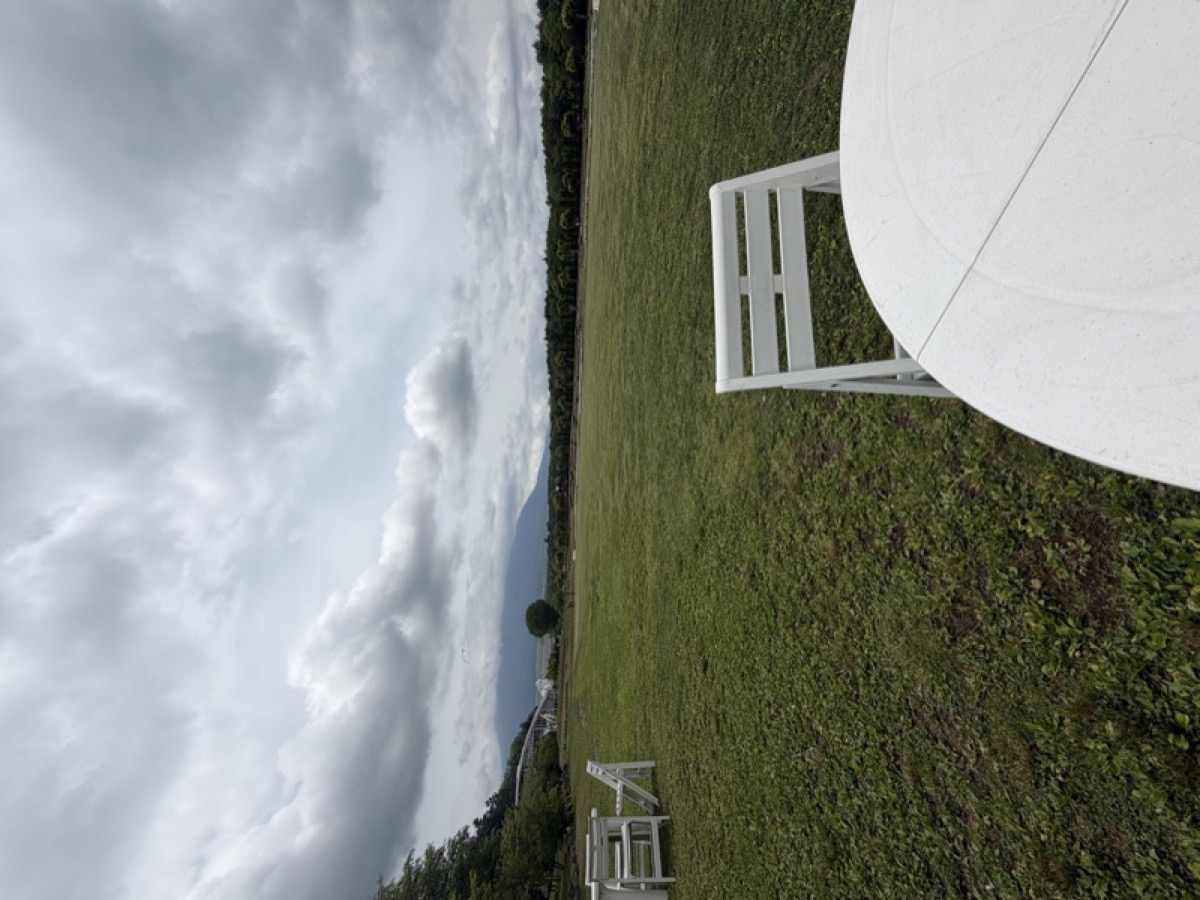
I wandered for over an hour before I realized how long I'd been there.
Because it was a weekday, almost nobody else was around. I said "oh" at the waterwheel without embarrassment. I stood silently at the falls. I scared myself underground.
The satisfaction wasn't in "having gone somewhere" — it was in "being somewhere." That's the weekday solo walk in your fifties.
Hananomiya Park + Beniuji no Yu: Complete Half-Day Timetable
| Time | Activity | Notes |
|---|---|---|
| 8:30 | Enter Hananomiya Park at opening | Fuji is clearest in the morning |
| 8:30–9:00 | Free zone (entrance & farmland area) | Cross the entrance bridge, check Fuji from the farmland — clearest in the morning |
| 9:00 | Enter paid zone (¥600, approx. $4) | Shoot nemophila + Fuji right after entering |
| 9:00–9:30 | Triple Waterwheel | Step back far enough to fit all three wheels in frame |
| 9:30–10:00 | Myojin Falls + Iwashimizu Falls | Don't rush — take time to just listen |
| 10:00–10:30 | Floral Dome Furara | Weather-proof — great even on cloudy days |
| 10:30–10:45 | Lava Tree Mold Underground Zone | Don't go alone. Prepare yourself mentally. |
| 10:45–11:00 | Gift shop / light snack / rest | |
| 11:00 | Leave the park | |
| 11:05 | Arrive at Beniuji no Yu hot spring | About 4 min / 1.7km by car or bike |
| –12:30 | Soak at leisure | |
| 12:30+ | Head home via Doshu Road |
Beniuji no Yu (紅富士の湯) — basic info
| Item | Details |
|---|---|
| Hours | Weekdays 11:00–19:00, weekends/holidays 11:00–20:00 (last entry 45 min before closing) |
| Closed | Mondays and Tuesdays |
| Distance from park | About 4 min / 1.7km by car or bike |
| Features | Open-air bath, sauna, rock bath. Smelt (wakasagi) cuisine available. |
Closed Mondays and Tuesdays. Opens at 11:00 — so arriving at 10:00 won't get you in. (Don't be me.)
Notes for motorcycle riders
- Gear: At 1,000m elevation in May, it can feel nearly 10°C cooler than lowland areas. Bring a windbreaker or leather jacket.
- Doshu Road access: Low traffic, natural extension of a great ride. Highly recommended.
- Parking: ¥300 (approx. $2) for passenger vehicles. On weekday mornings, completely empty.
- Best time: Weekday mornings — fewer crowds, better chance of seeing Fuji.
Final thoughts: The days that don't go to plan
Riding home on the Doshu Road, I kept thinking: "That was genuinely good."
I could still hear the thin, clear sound of Myojin Falls somewhere in my memory.
An accidental hour — arriving at the hot spring too early — sent me into a park I'd skipped for a decade.
I said "oh" out loud in front of a waterwheel with nobody around. I stood at a waterfall and stopped thinking. I scared myself in an underground cave and whispered my own name.
All of it started with something going wrong.
I've noticed something in my fifties.
The days that don't go to plan are the ones I remember most.
Days where everything worked perfectly, where the plan held — I forget those. Days where something broke, but it still worked out — those stay with me.
Arriving too early at a hot spring led me to a park I should have visited years ago. "Maybe I'll skip it" is almost always the wrong call.
Riding home, I wanted to tell someone about the day.
I thought about who I'd tell. And then felt a little lonely for a moment.
So I wrote it here instead.
If this got you thinking "maybe I'll check it out" — that's all I needed.