Read time: About 8 minutes
Hi, I'm Hiroshi.
It's overcast. Foggy, actually. But my wife is in full gear anyway.
Sun hat, face mask, sunglasses, long sleeves, gloves. She walked up to the Mt. Nokogiriyama ropeway station looking like she was about to summit Everest. Rain or shine, my wife's "Tutankhamun Mode" is non-negotiable. I've made my peace with it.
Our destination today: Nihon-ji Temple on Mt. Nokogiriyama, Chiba Prefecture.
A few weeks ago, I visited the Nagoyama Bussharitou in Himeji and felt like I'd stumbled into Gandhara. Now Chiba pulled the same trick on me. Japan, apparently, is full of Gandharas. (Read the Himeji Gandhara story here)
We also brought our Shiba Inu, Momiji — who by the end of the day had nearly achieved enlightenment through sheer exhaustion.
Who this post is for
- Anyone looking for a solid day trip from Tokyo or Kanagawa
- People drawn to a place called "Hell's Lookout" (and honestly, who isn't?)
- Those who know there's more to Japan's giant Buddha statues than Nara
- Dog owners wondering if they can visit temples with their pets (Momiji field report included)
- Anyone who has ever tripped on a mountain path and sprained their ankle (solidarity)
The answer first: Mt. Nokogiri with a dog, at a glance (visited May 2026)
| Dog-friendly? | Yes — leashed dogs are allowed on the Nihon-ji temple grounds. The ropeway takes small dogs under 10 kg for 300 yen each way (our Shiba Inu just made the cut) |
| Time needed | 2 to 2.5 hours to walk the Great Buddha, the 1,500 Rakan corridor, Hell's Lookout, the Hyakushaku Kannon, and the "Laputa Wall" |
| Difficulty | Lots of stairs and steep, uneven stone paths. Doable in your 50s, but wear proper shoes (says the man who sprained his ankle) |
| Fees | Ropeway round trip 1,200 yen + temple admission 700 yen |
| Parking | Ropeway parking lot No. 1: 600 yen on weekends and holidays |
| Access | Train: 8–9 min walk from JR Hamakanaya Station (about 2 hours from Tokyo). Car: Futtsu-Kanaya IC via the Aqua Line |
And the one-line verdict: Chiba's Gandhara is the real deal. I sprained my ankle. But I want to go back.
Table of Contents
- Fees and Access — Let's Sort That Out First
- The Ropeway Swallowed Us in Fog
- Welcome to Chiba's Gandhara — The Great Buddha
- How I Sprained My Ankle in the 1,500 Rakan Corridor
- Hell's Lookout — The Fog Made It Scarier
- The Hyakushaku Kannon and the Laputa Wall
- The Croquette Shop Where a Rock Star Apparently Showed Up
Fees and Access — Let's Sort That Out First
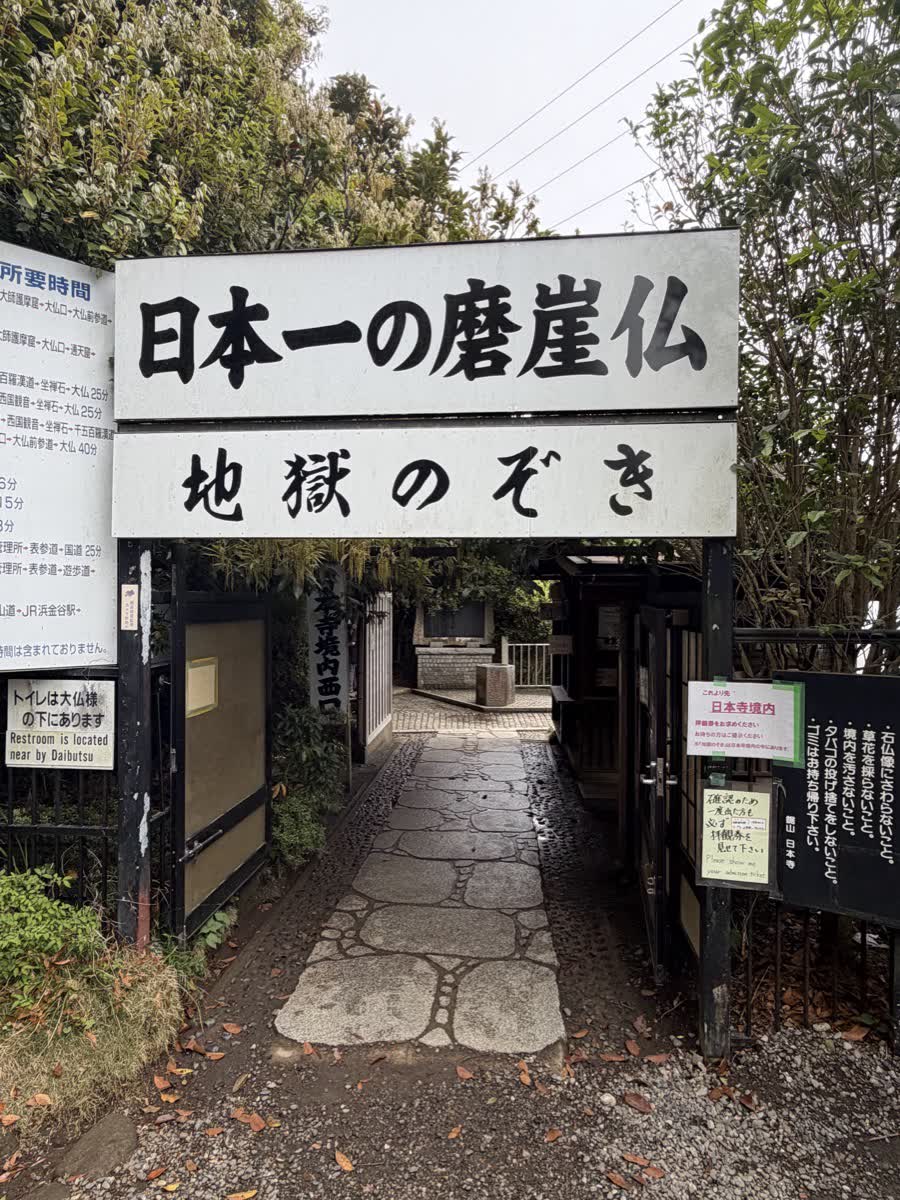
Before anything else, let's clear up the cost question. Mt. Nokogiriyama has three separate things going on: the mountain itself (free to hike), Nihon-ji Temple (admission fee), and the ropeway (separate fare). Understanding these separately saves confusion at the gate.
| Item | Price |
|---|---|
| Ropeway round trip (adult) | $8 USD |
| Ropeway (small dog, one way) | $2 USD |
| Nihon-ji Temple admission (adult) | $5 USD |
| Ropeway parking lot (weekends/holidays) | $4 USD |
Pets: Dogs under 10kg can ride the ropeway for a one-way fee of about $2. Momiji (Shiba Inu) made the weight limit — just barely.
Hours: Nihon-ji Temple 9:00 AM–4:00 PM (last entry 3:00 PM), Ropeway 9:00 AM–5:00 PM
Access: From Hamakanaya Station (JR Uchibou Line), it's about an 8–9 minute walk to the ropeway base station. From Tokyo Station, allow roughly 2 hours and about $13 USD in train fare.
Pets are welcome inside the temple grounds on a leash. That said, the terrain is steep and uneven — sturdy shoes are essential. (I'll explain why from personal experience shortly.)
How long does it take? From the ropeway base station, the full circuit — Great Buddha, 1,500 Rakan corridor, Hell's Lookout, Hyakushaku Kannon, Laputa Wall, and back down to the base — takes roughly 2 to 2.5 hours. Build in extra time if your footwear is questionable. And a little extra if you sprain your ankle, which is, admittedly, a specific scenario.
The Ropeway Swallowed Us in Fog
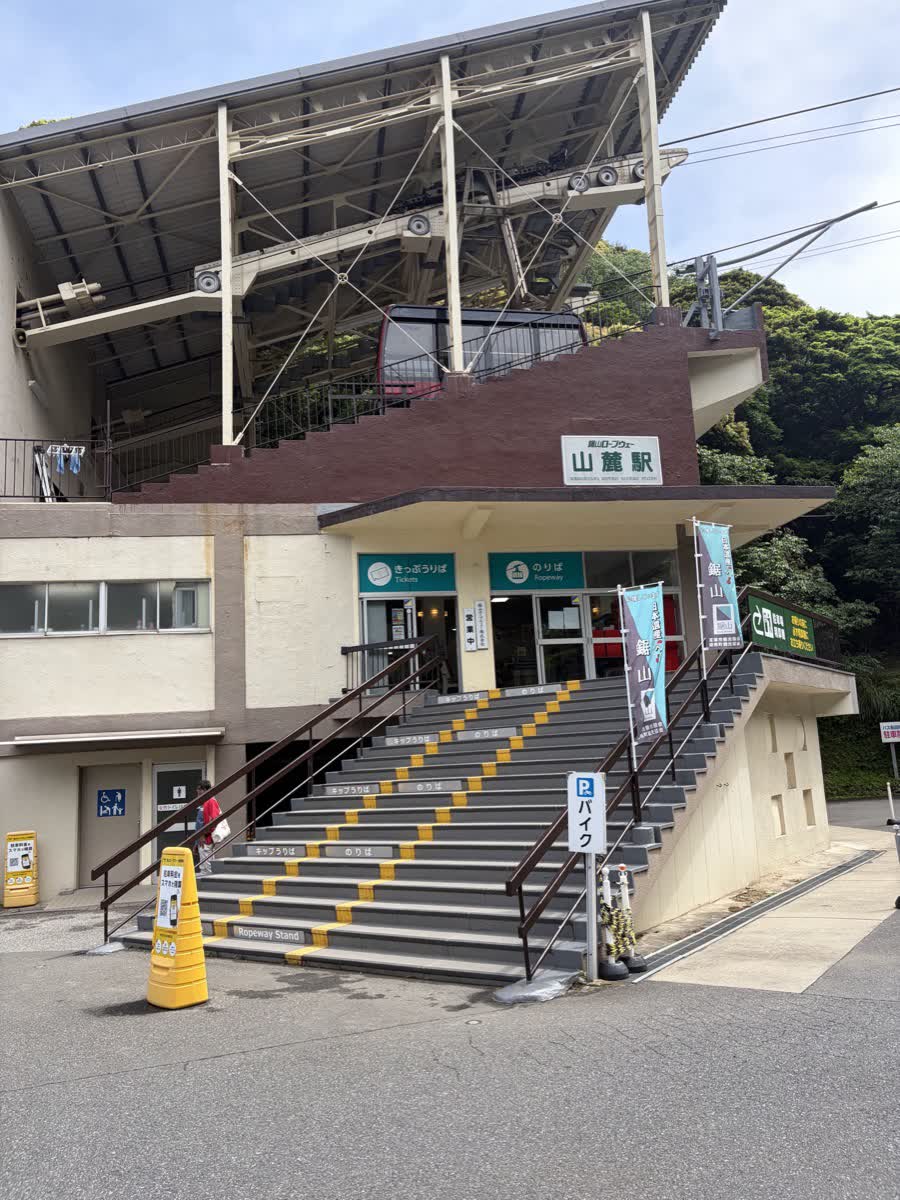
We boarded the ropeway at 10:00 AM sharp.
The ride takes about four minutes. As we climbed, the view outside turned whiter and whiter. Dense fog. "I'm guessing we won't be able to see much from the top," I thought.
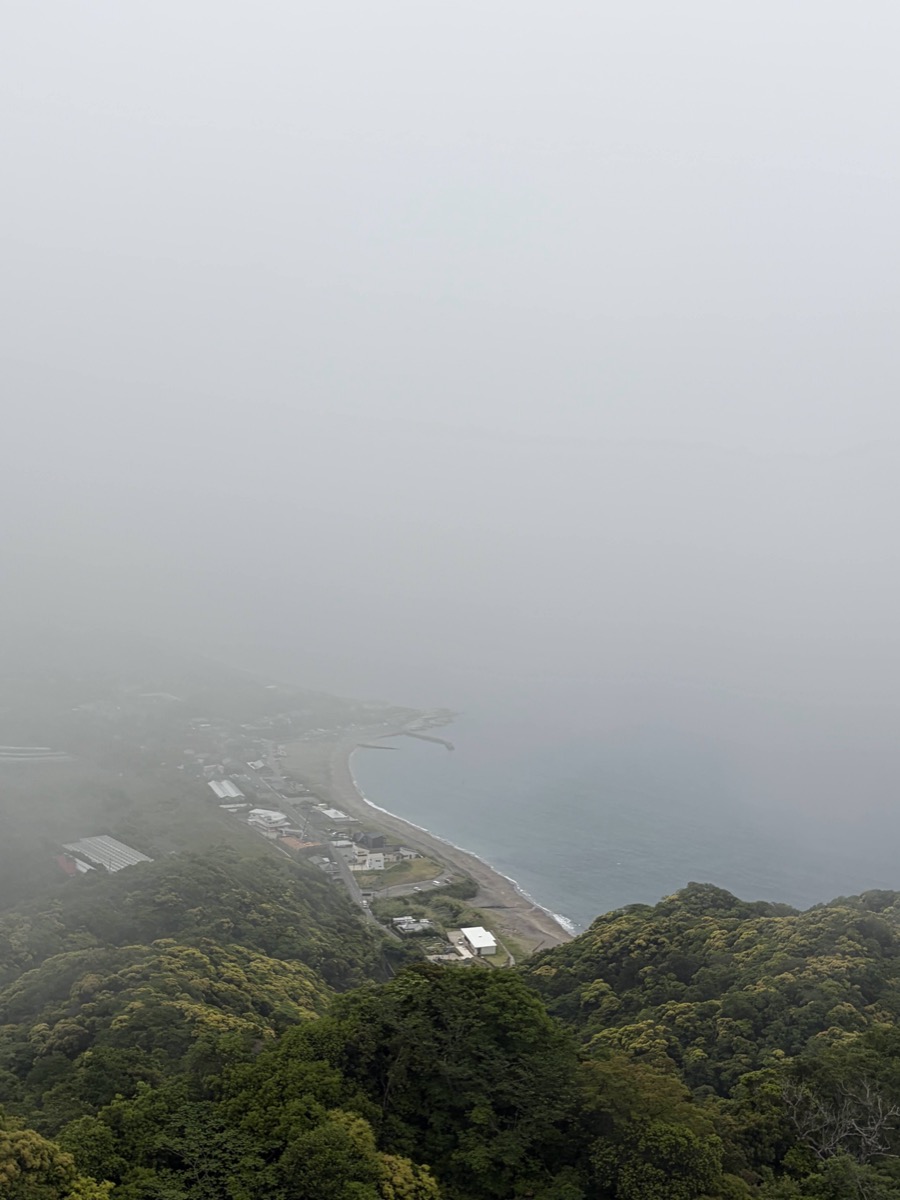
I was right. At 10:23 AM we arrived at the summit station — and the fog was thick.
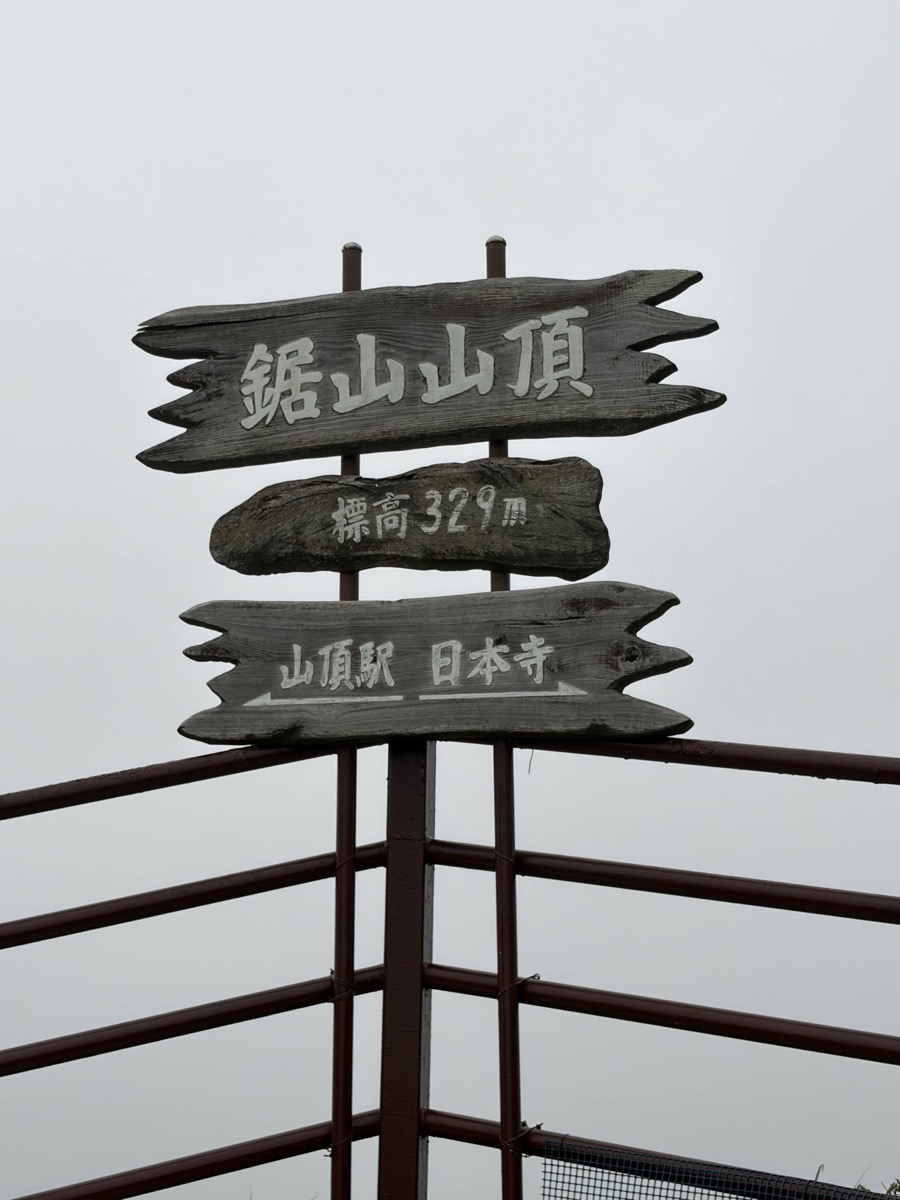
The wooden sign reading "Nokogiriyama Summit Station · Nihon-ji · Elevation 329m" greeted us. I liked it — it had character.
Sadly, the panoramic observation point known as the Jusshu Ichiran-dai (the "Ten Provinces View") was completely socked in. Tokyo Bay: invisible. Mt. Fuji: invisible. This spot is listed among the "100 Fuji Views of the Kanto Region," but today it was delivering exactly zero views.
"Well, this is atmospheric in its own way," I told myself, and moved on.
Welcome to Chiba's Gandhara — The Great Buddha
We walked from the summit station toward the temple. Admission to Nihon-ji costs about $5 per adult — this is where the main event begins.
A quick history note: Nihon-ji was founded in 725 AD by the monk Gyoki, and 2025 marks its 1,300th anniversary. The temple is now a Soto Zen institution. Minamoto no Yoritomo — the founder of Japan's first shogunate — once prayed here for victory in battle and later rebuilt the main hall in 1181.
At 10:56 AM we reached the approach to the Great Buddha. At 11:00 AM sharp, we arrived at Daibutsu Plaza.
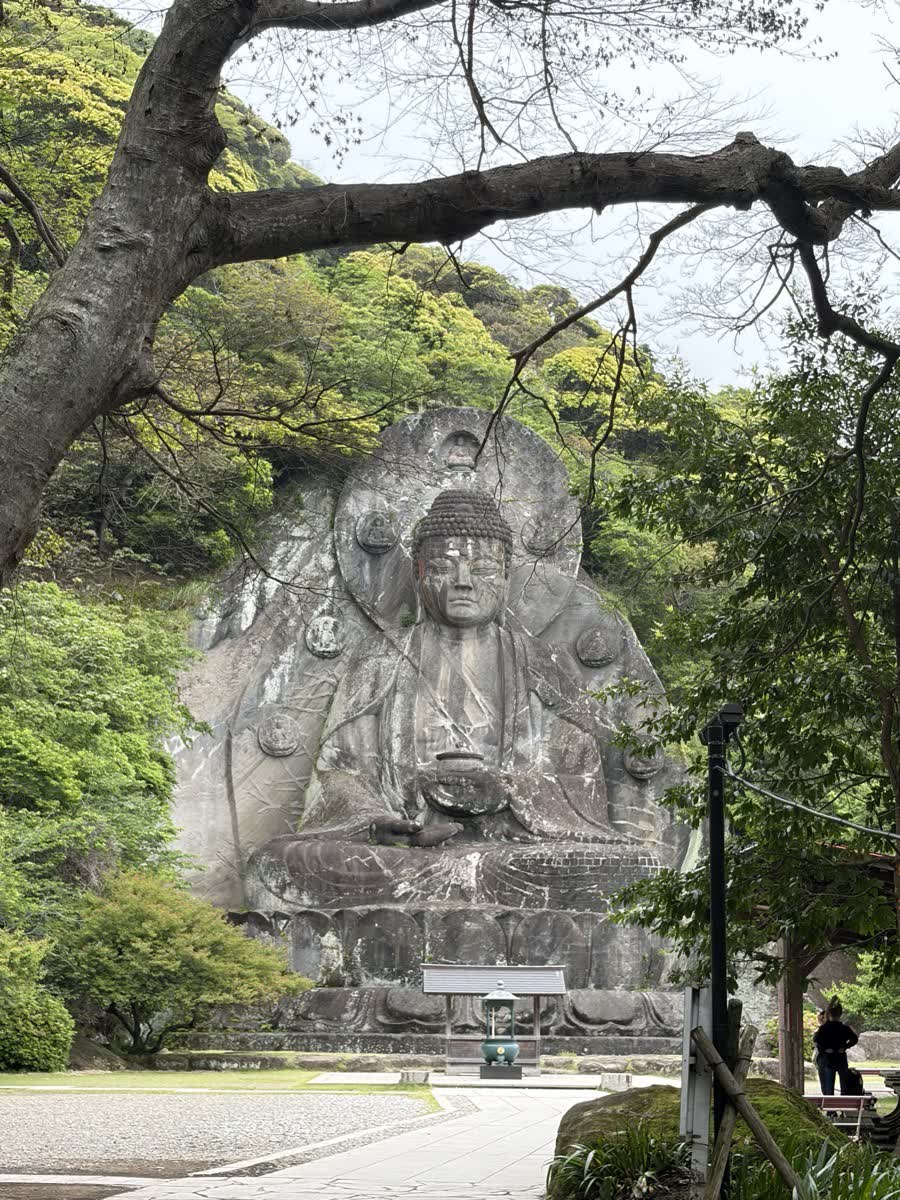
It's massive.
Standing 31.05 meters tall — more than twice the height of the famous Nara Great Buddha at 14.98 meters — this is a magaibutsu: a Buddha carved directly into the living rock. The original was completed in 1783; the current restoration dates to the Showa era.
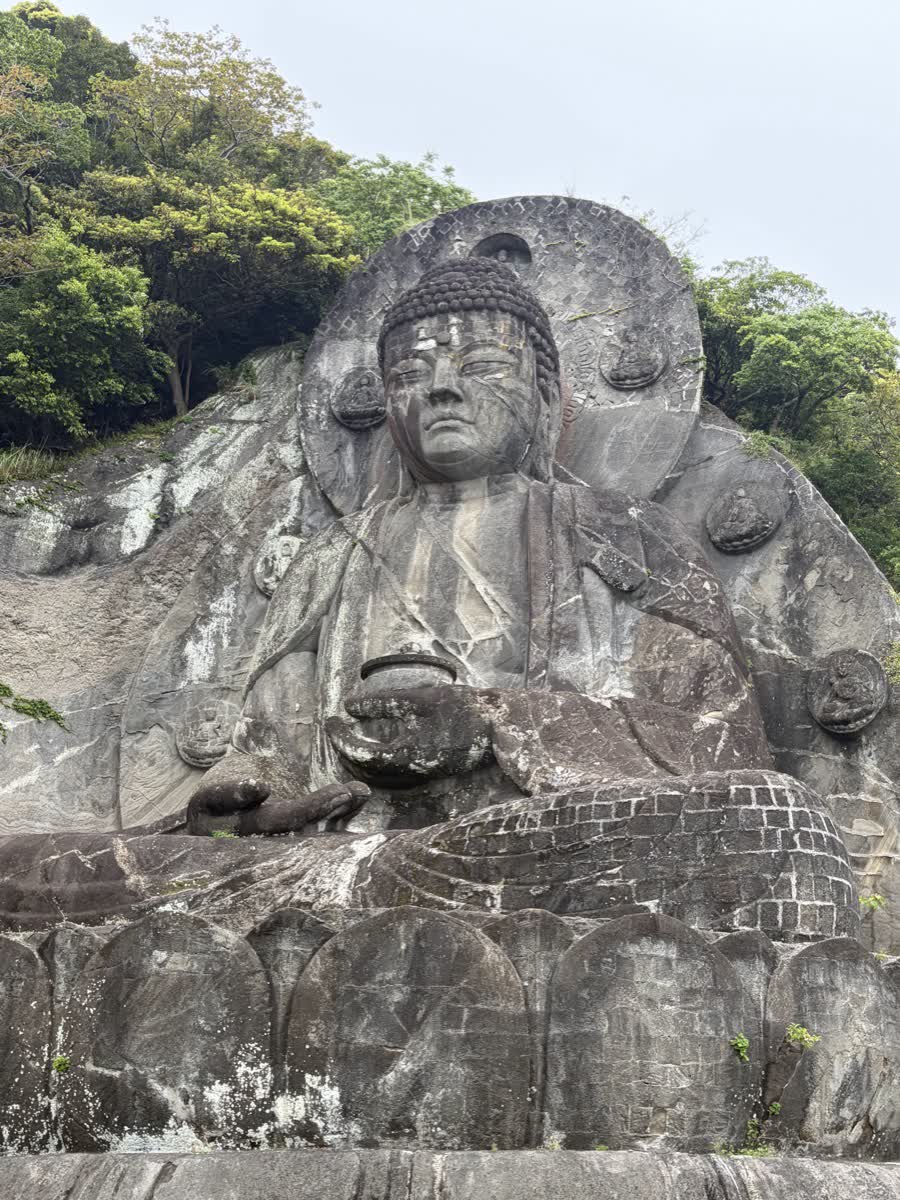
The expression is serene. Even wrapped in fog, you can feel it.
And then: the shot of the day.
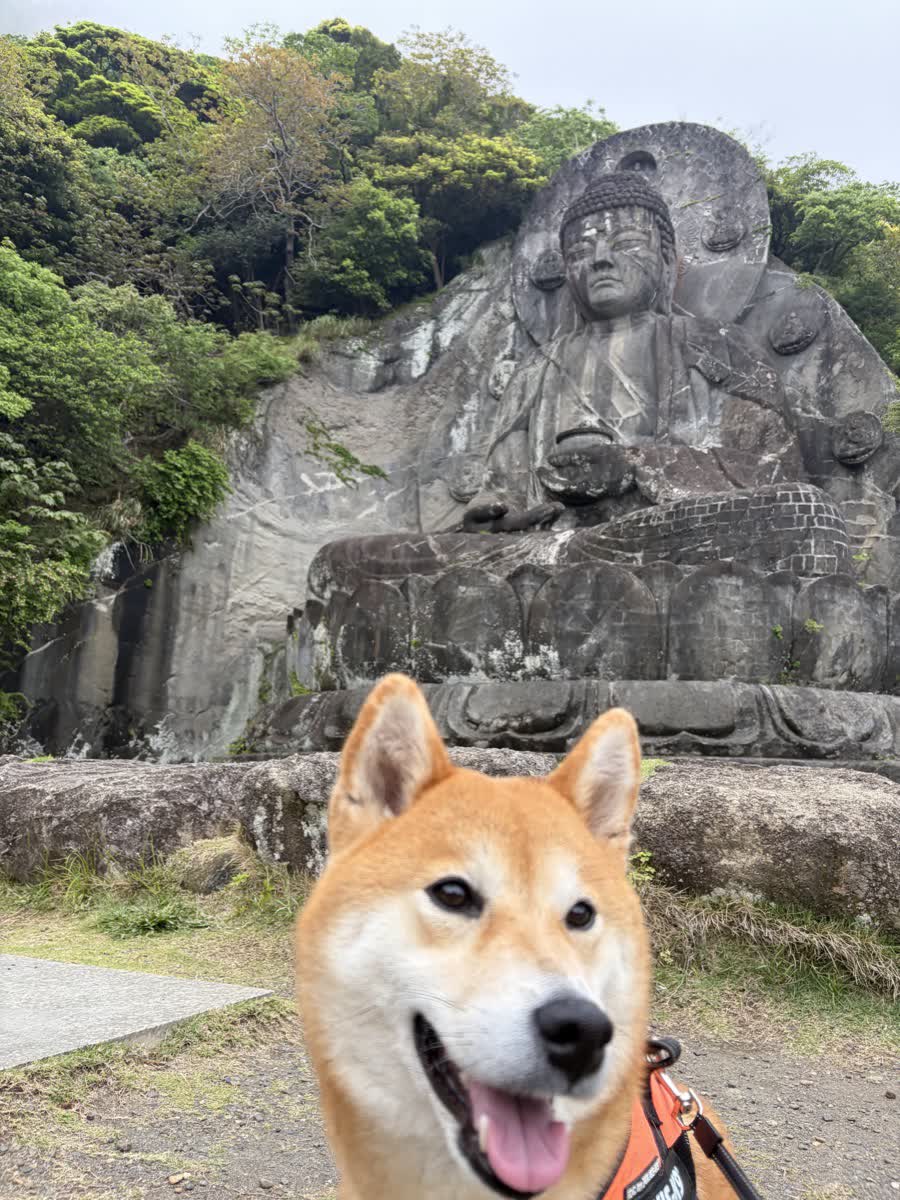
Momiji: tongue out, tail wagging, completely unbothered by the gravitas of the situation.
Thirteen centuries of Buddhist history behind her, and she's grinning like she just found a great stick. Honestly the best photo I've ever taken.
How I Sprained My Ankle in the 1,500 Rakan Corridor
From Daibutsu Plaza, we headed into the Higashi Sengo Rakan — the corridor of 1,553 stone figures.
The story behind them: in 1780, the head priest Koga Uden commissioned sculptor Ono Jingoro Hidenori and 27 apprentices to carve every single figure over 21 years. Each one has a different face. Some are laughing, some stern, some look half-asleep.
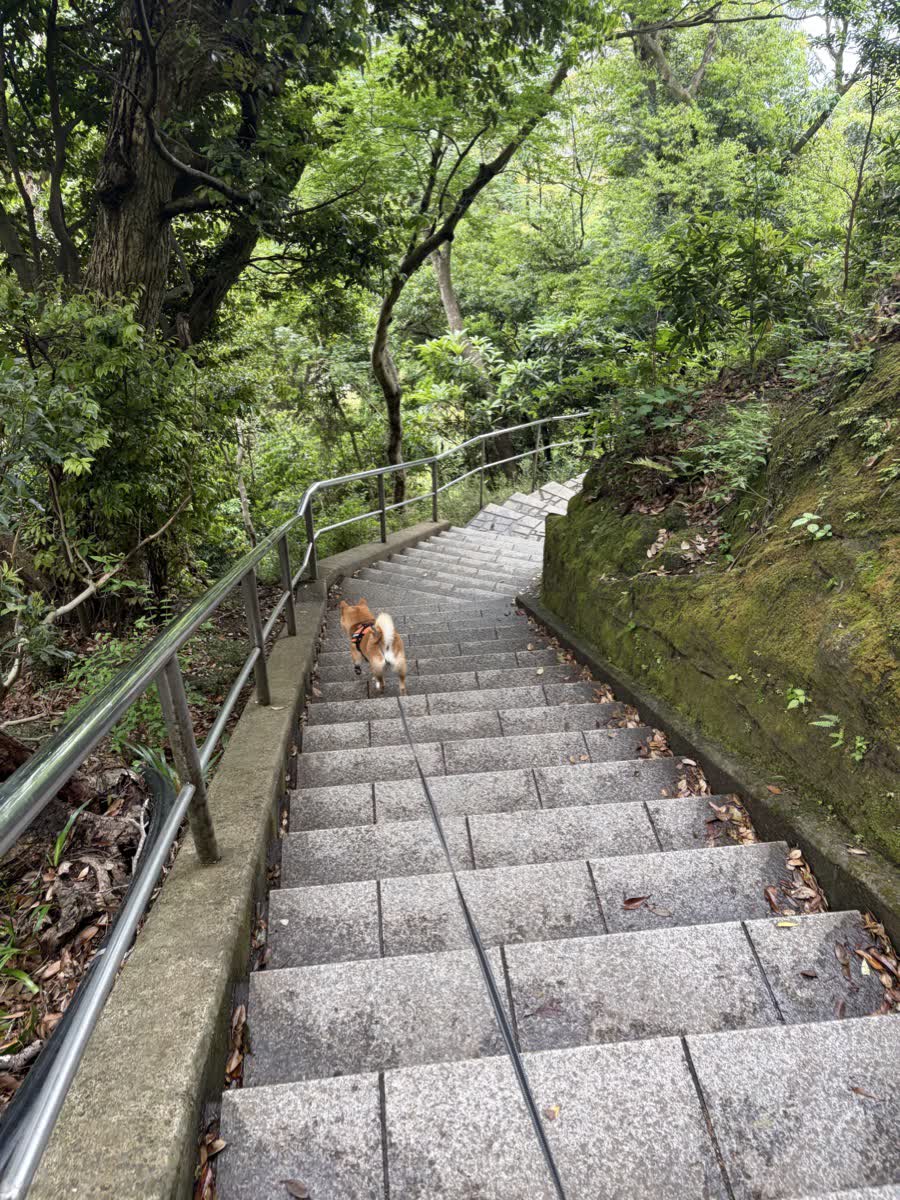
Momiji charged up the stone steps without hesitation. Dogs have an unfair structural advantage on terrain like this, and I say that with complete seriousness.
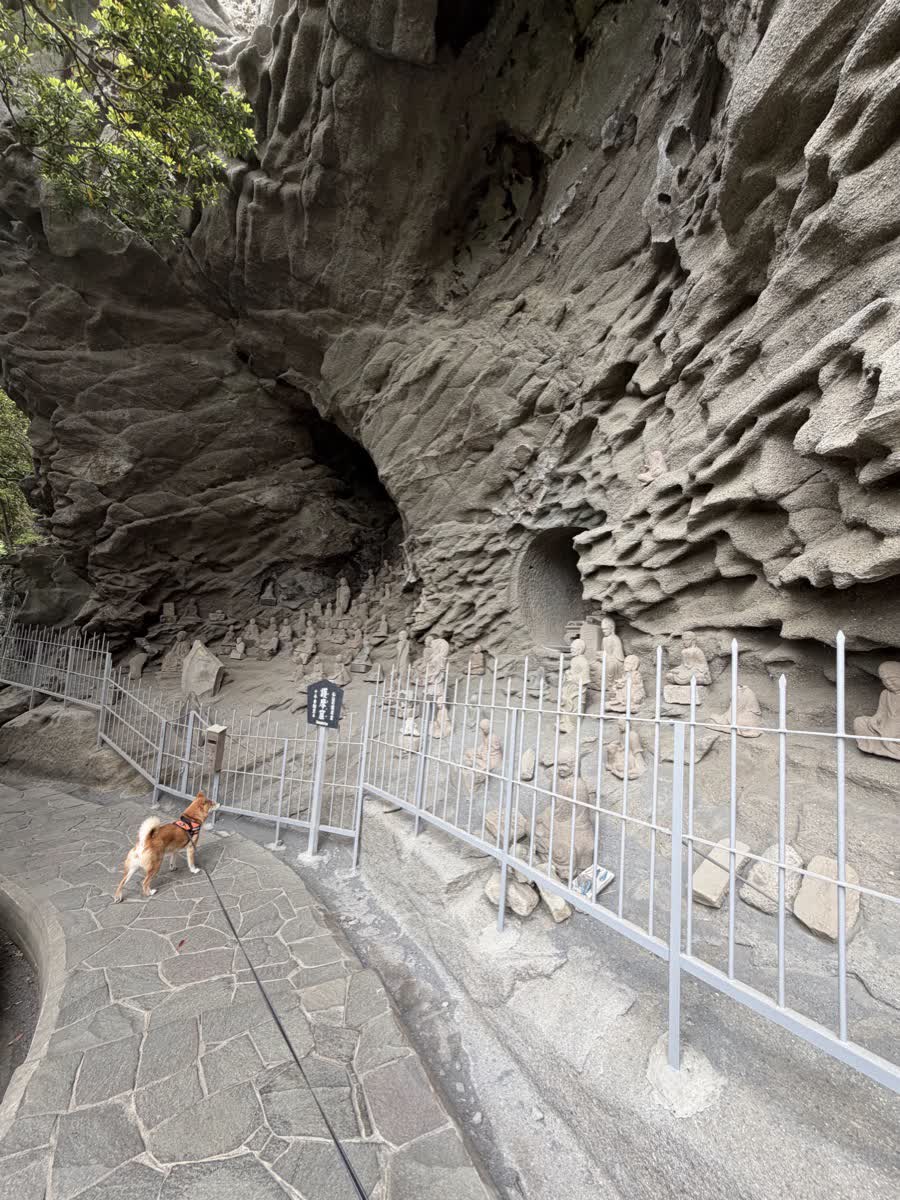
The corridor closes in on both sides, with stone figures tucked into every crevice and overhang. It felt like walking through a different world entirely.
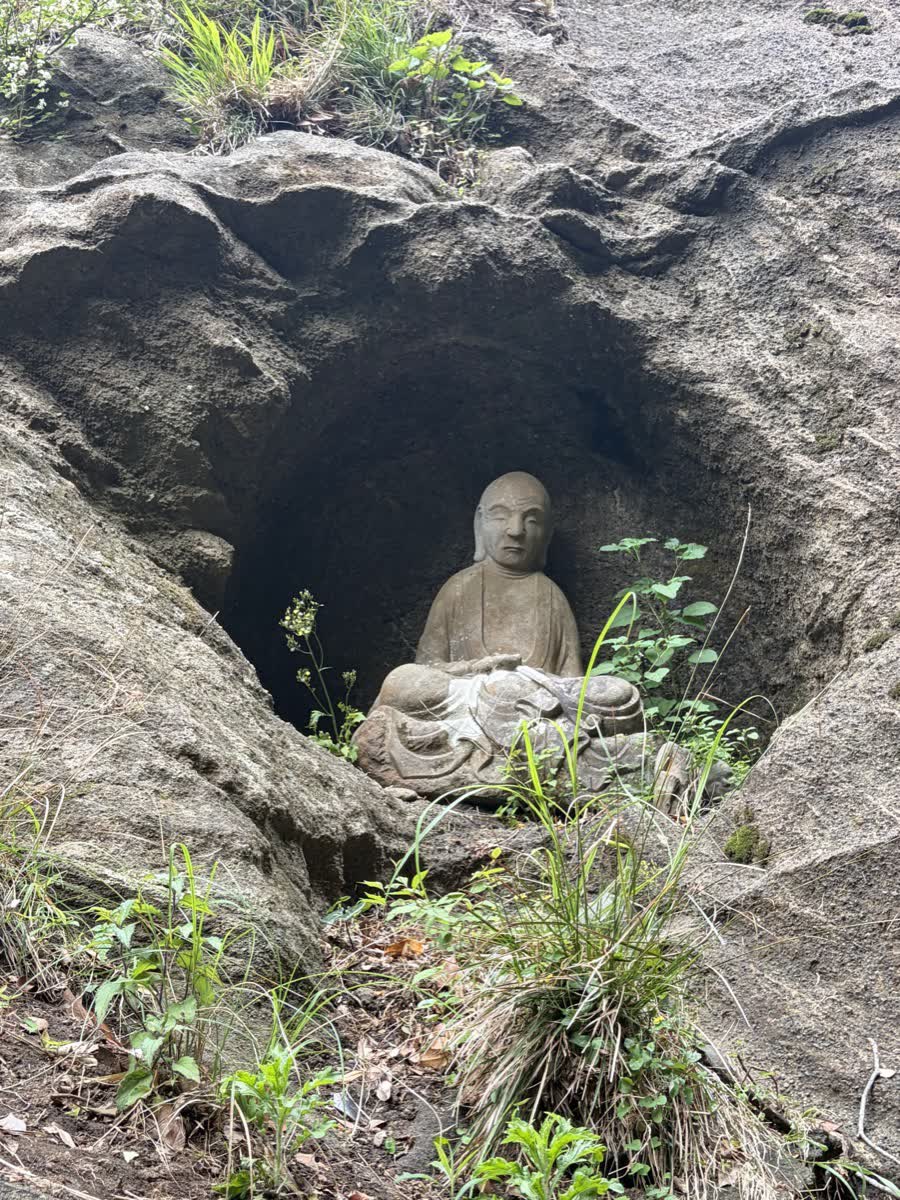
Then, at around 11:30 AM, on a completely ordinary-looking slope, I slipped.
Sprained my ankle.
Not on the stairs. Not on the roped section. Just on a normal inclined path. My wife, sealed in full Tutankhamun Mode, was fine. I twisted my ankle on a moderate slope in regular sneakers.
I could still walk, so I kept going — but every step for the rest of the day came with a dull throb in my ankle.
Lesson: proper footwear is non-negotiable here. You don't need hiking boots, but thin-soled sneakers are genuinely risky. Trust the person who found out the hard way. Check out more of our dog-friendly walks around the Kanto region for comparison.
Hell's Lookout — The Fog Made It Scarier
Via Fudo Waterfall, we reached the summit observation area — Jigoku Nozoki, or "Hell's Lookout" — at 11:47 AM.
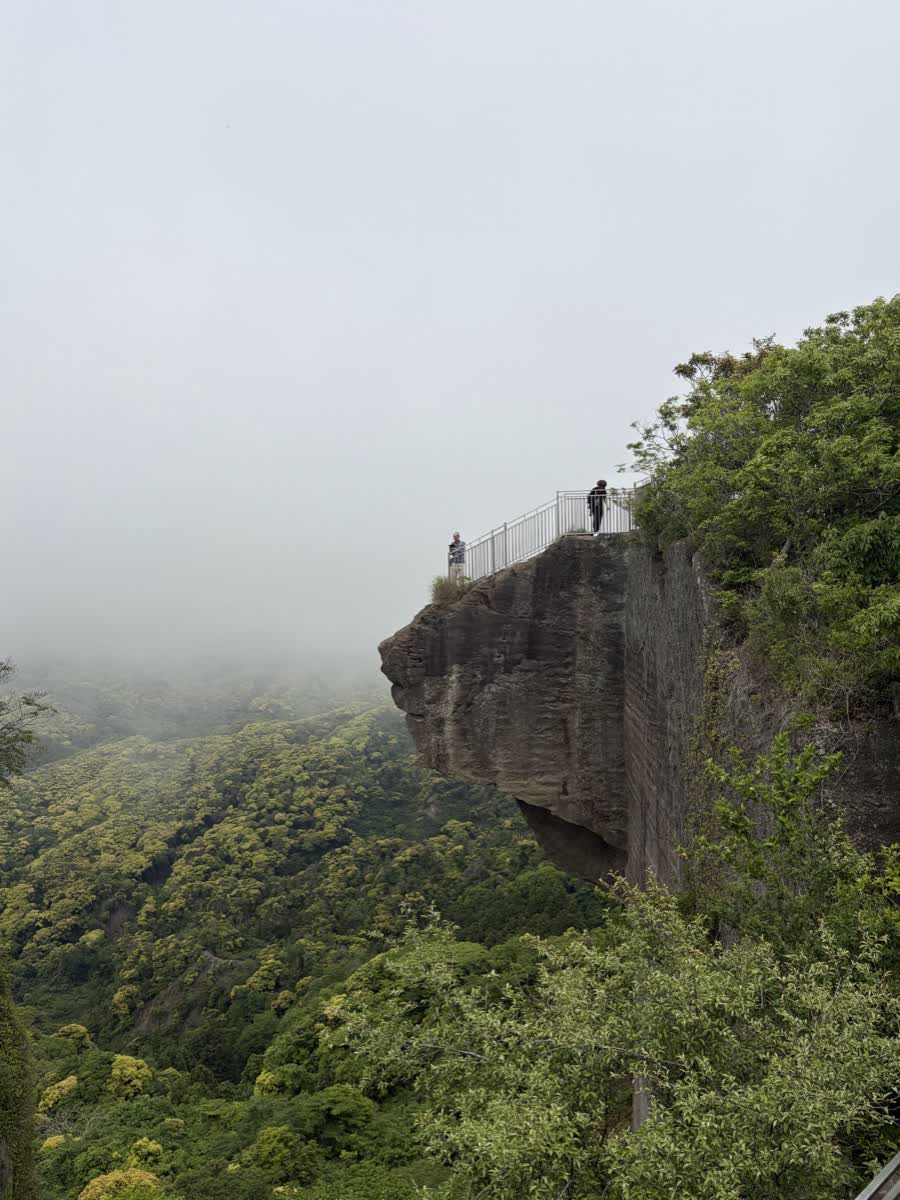
This is the famous one: a rock ledge that juts out dramatically over the valley below. On a clear day, you can see Tokyo Bay spread out beneath you.
Today: pure white fog below. You couldn't see the bottom.
Counterintuitively, that made it scarier. Standing on the edge and not being able to see how far down it goes produces a specific kind of dread that's actually worse than seeing the drop clearly. I was genuinely more nervous than I expected.
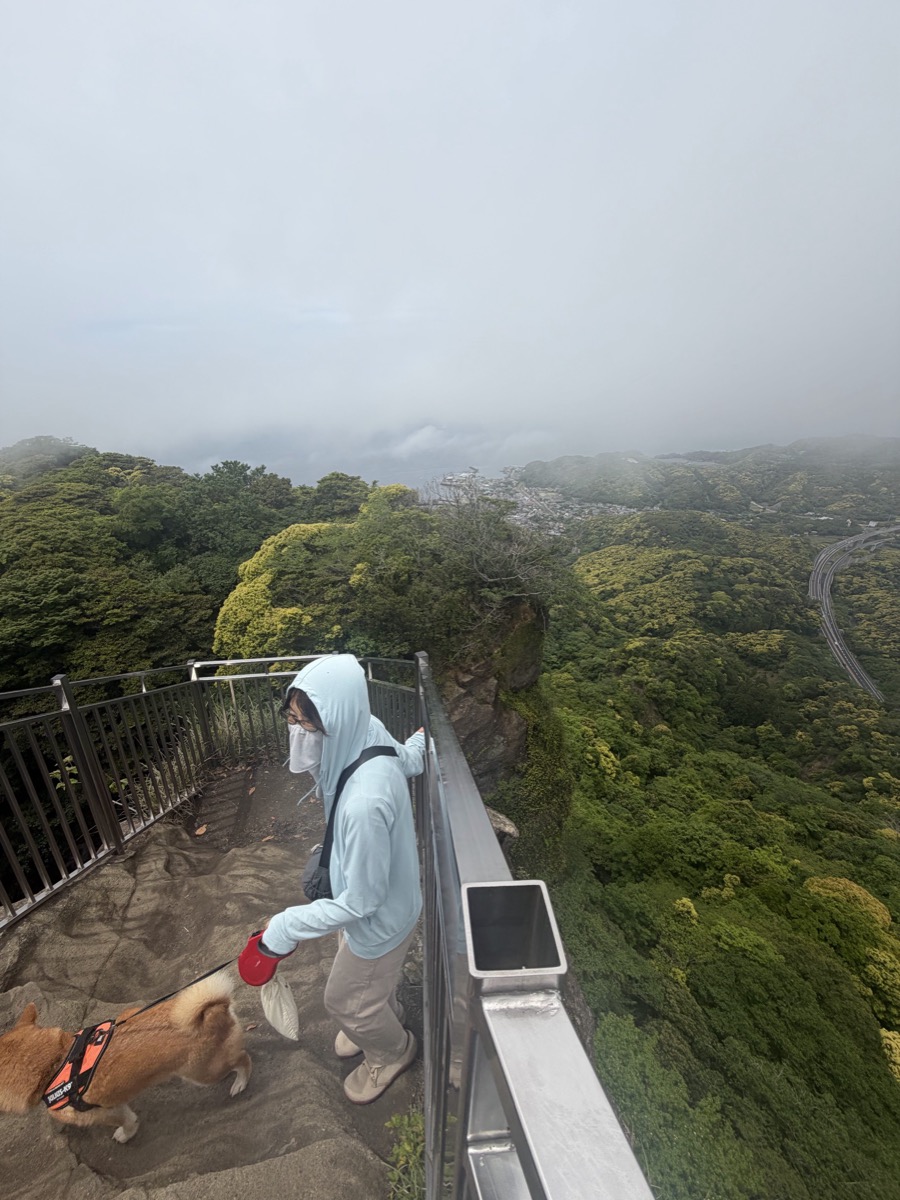
My wife and Momiji stood at the edge. The full Tutankhamun gear against a wall of white fog was, I have to admit, a striking image. Other visitors were probably wondering who she was.
Near the lookout, there's an AR marker where you can point your phone and see a digital recreation of the rope bridge that supposedly connected the rock before it became "Hell's Lookout." Mine loaded fine — the stonecutters appeared and moved around. Worth a look if your phone cooperates.
The Hyakushaku Kannon and the Laputa Wall
At 12:09 PM: the Hyakushaku Kannon.
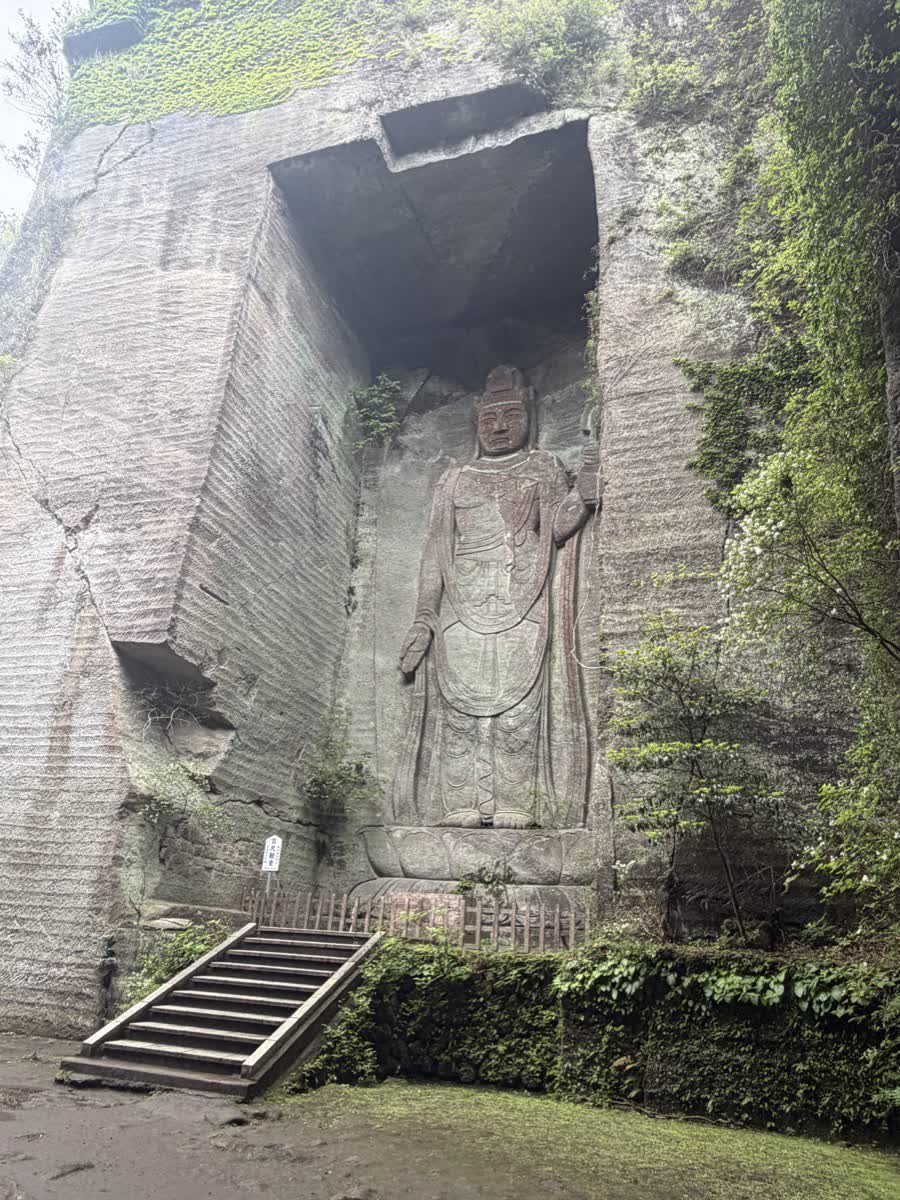
Carved into the face of the old quarry cliff, this standing figure is approximately 30 meters tall. It was carved between 1960 and 1966 — a modern work, but no less impressive for it. Six years of hand-carving into living rock.
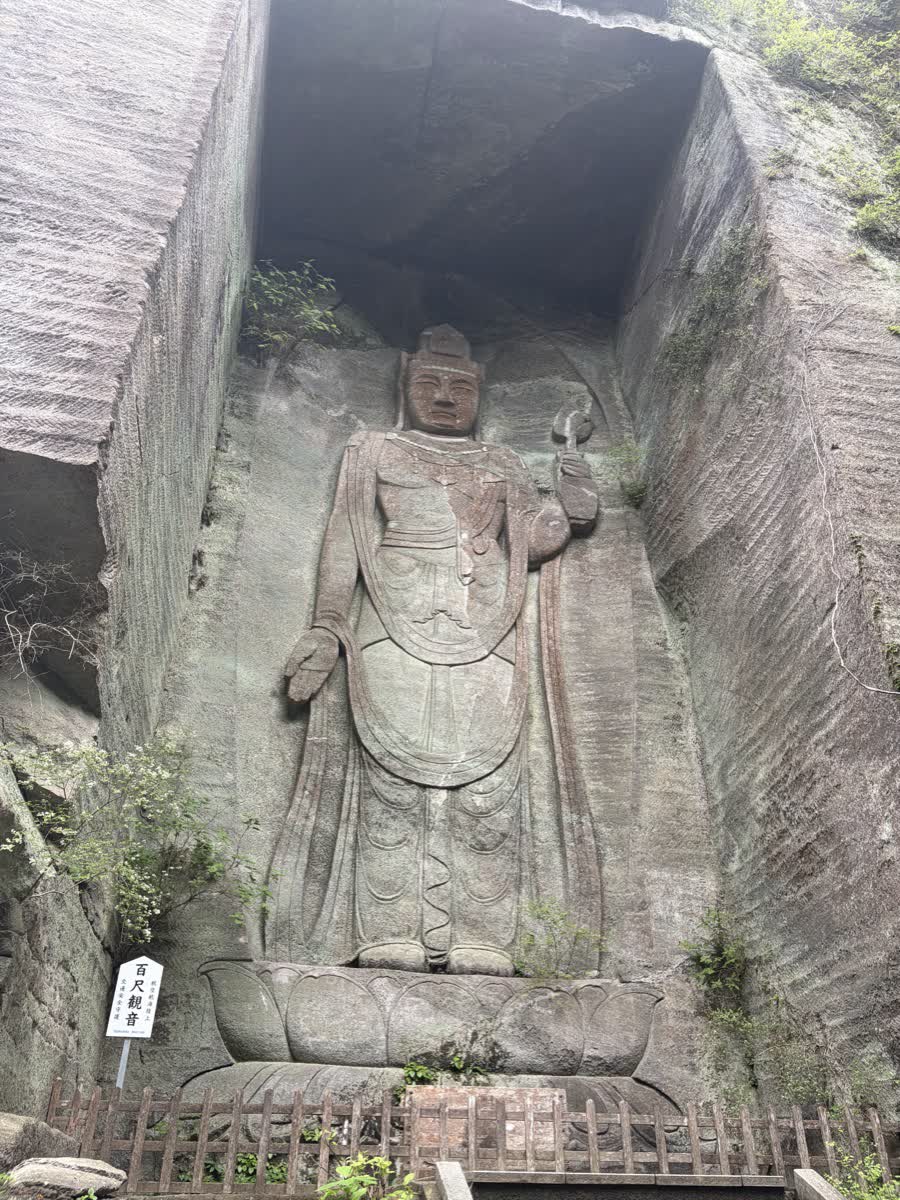
You have to lean all the way back to see the full figure. The scale drives home just how much work went into it. Standing right next to it, you get a very clear sense of how small you are — not just physically, but in some harder-to-define way. Maybe that's what reverence feels like. Or maybe I just needed lunch.
Then, at around 12:05 PM, we passed through the old quarry zone — what locals and visitors have come to call the "Laputa Wall."
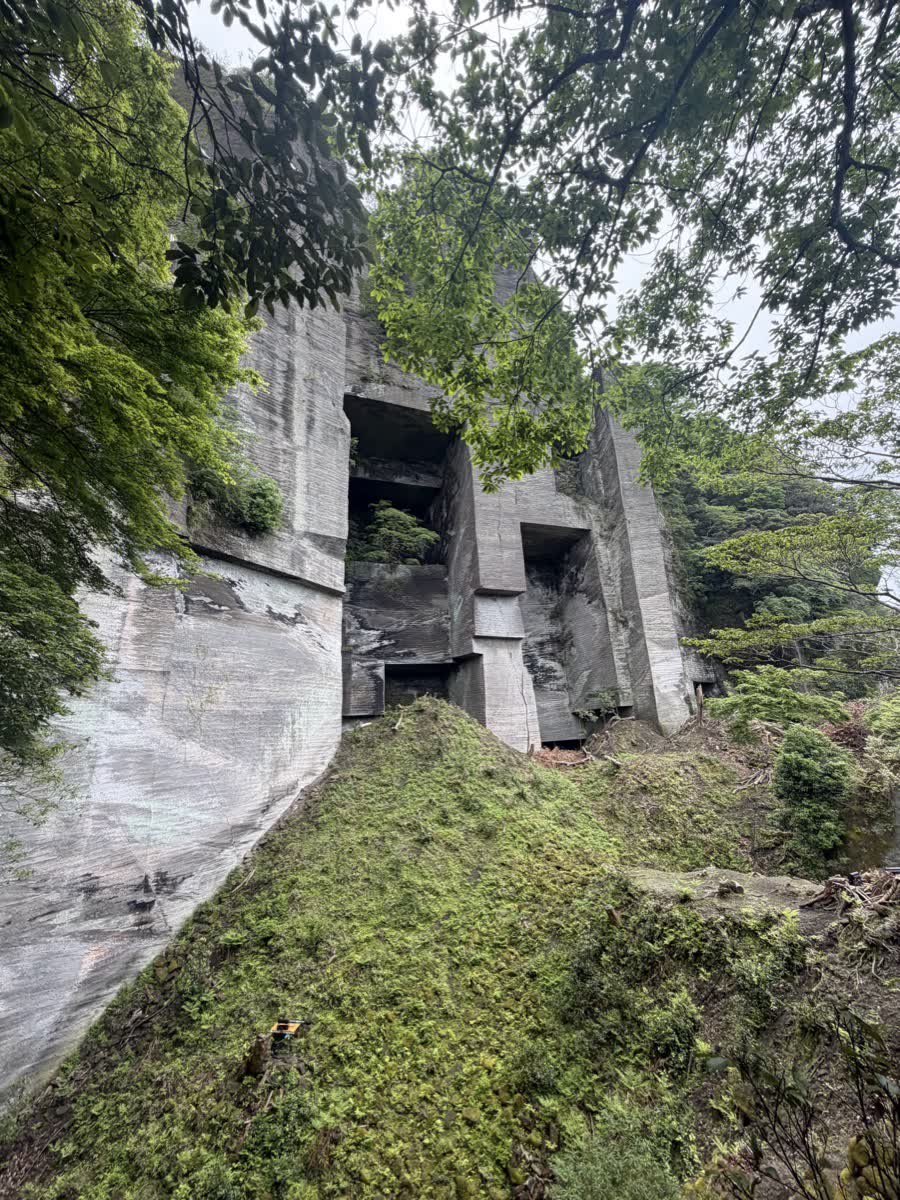
The geological backstory: the summit area of Mt. Nokogiriyama contains Boshu-ishi, a type of tuffaceous sandstone that is easy to cut but fire-resistant. Quarrying began in the Edo period and only ended in 1985. The stone was used in the construction of Yokohama Port, island fortifications, and much more.
The "sawtooth" silhouette that gives the mountain its name — Nokogiri means "saw" — is literally the result of all that stone cutting. The boundaries between natural landscape and human intervention are completely blurred here, and that's what makes it unlike anywhere else in the Kanto region.
There's also an AR marker showing the quarry workers in action. Mine loaded. Genuinely interesting.
At 12:15 PM we headed to the Kanaya descent gate and started down the mountain.
The Croquette Shop Where a Rock Star Apparently Showed Up
We reached the bottom at 1:00 PM.
My ankle was aching. I was hungry. And then I spotted a sign: "Sassei Butcher Shop — Croquettes, $0.65 each."
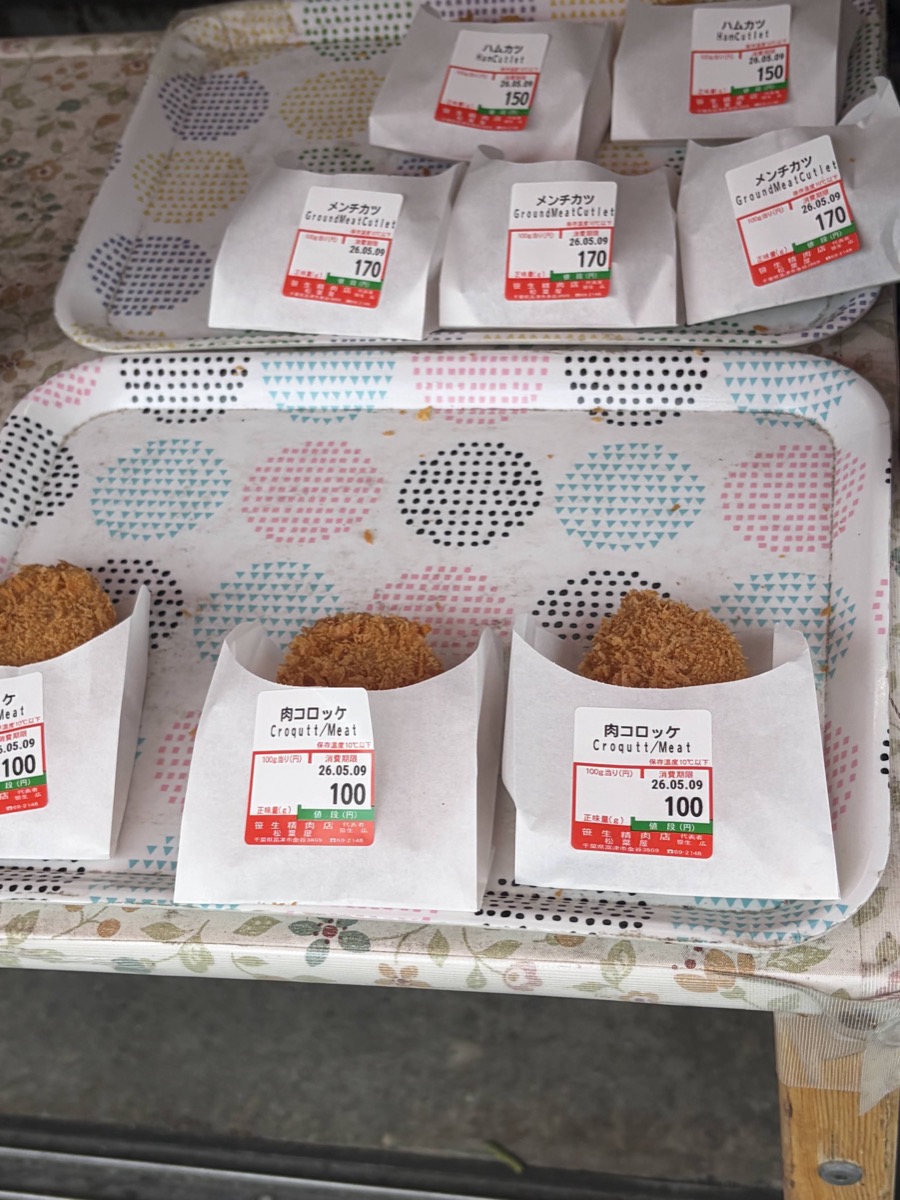
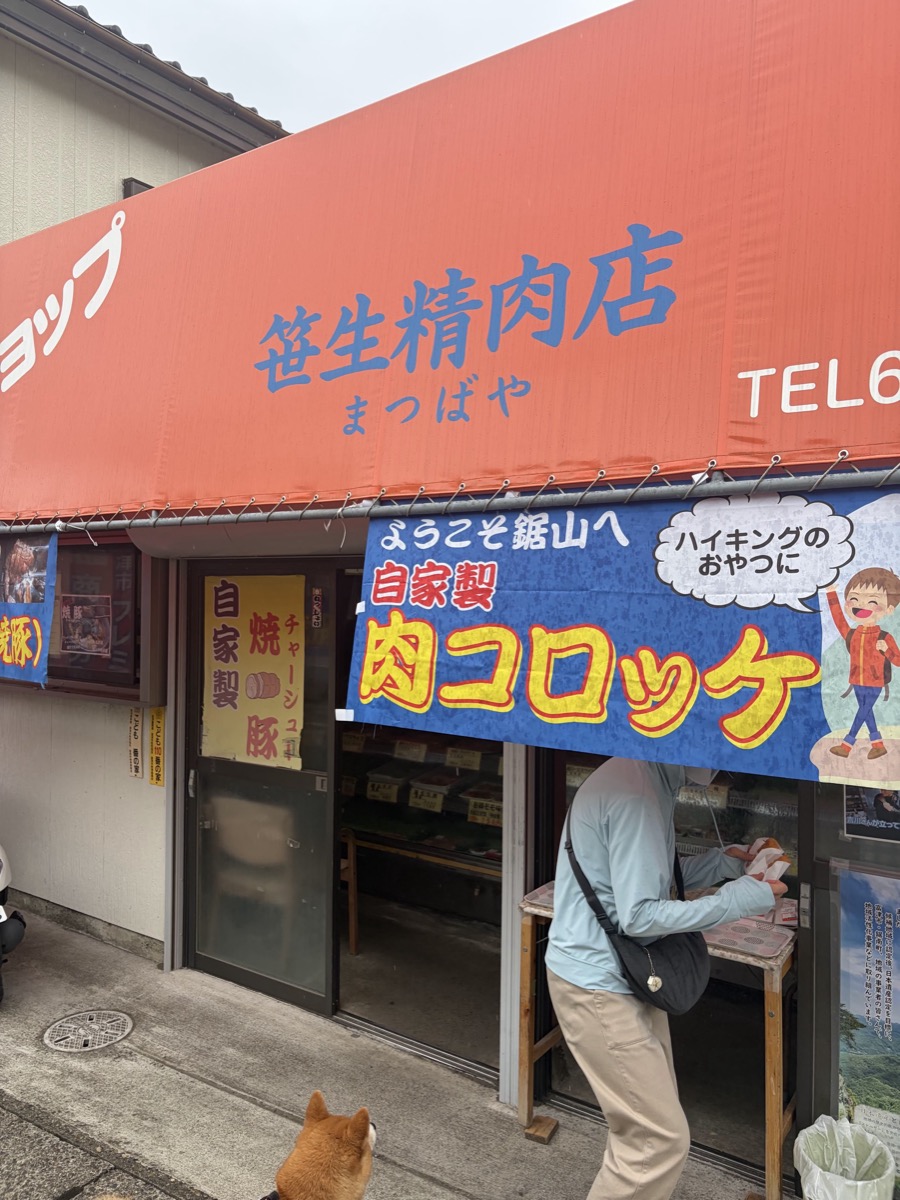
Cold croquettes after a mountain hike hit differently. Genuinely good.
Then I noticed something on the shop's display wall: photos and a write-up indicating that Koji Kikkawa — one of Japan's most iconic rock musicians — had visited this exact shop.
Let me process that for a moment.
Koji Kikkawa. Japan's actual rock legend. I hiked through fog, saw Japan's largest stone Buddha, stood on Hell's Lookout, sprained my ankle on a completely normal slope, and the day ends with a Koji Kikkawa celebrity sighting at a croquette shop. This is a lot of information for one afternoon.
I told my wife. She was still in full Tutankhamun Mode. She said "Oh, really." And looked back at her phone. That was the entire reaction. A rock legend has graced this very establishment and that's what I got. I've made my peace with it.
Momiji, meanwhile, was collapsed on the sidewalk in front of the shop. By the last stretch of the hike she'd been moving at half speed, clearly running on fumes. At the Great Buddha she was bouncy and tongue-out happy. By the time we got to the croquette shop, she was doing her best impression of someone who has achieved complete detachment from the physical world. For more of our dog-friendly walking adventures, here's the Okutama story.
Quick Reference
| Item | Details |
|---|---|
| Address (Nihon-ji) | 184 Motona, Kyonan-machi, Awa-gun, Chiba |
| Temple admission | Adults ~$5, Children ~$3 |
| Hours | 9:00 AM–4:00 PM (last entry 3:00 PM) |
| Ropeway | Round trip ~$8 (adult) / One way ~$2 (small dog, under 10kg) |
| Ropeway hours | 9:00 AM–5:00 PM (suspended in bad weather) |
| Parking | Ropeway lots: ~$3–4 / East gate: Free |
| Access (train) | ~8–9 min walk from Hamakanaya Station (JR Uchibou Line) |
| Restrooms | Below Daibutsu Plaza, ropeway base and summit stations |
| Vending machines | Base station, summit station, west gate management office, Daibutsu Plaza only |
| Pets | On leash in temple grounds; ropeway allows dogs under 10kg (one-way ~$2) |
Crowds peak around 11:00 AM on long weekends — parking lots can fill up. Arriving by 9:00 AM on weekends is the safe call. The ropeway suspends service in bad weather, so check current status before you go.
Footwear: running shoes minimum, light hiking shoes preferred. The stairs and rock paths get slippery, especially after rain. Water: bring your own — vending machines are limited to specific points on the route.
Mt. Nokogiriyama's Nihon-ji Temple rewards you whether you do the whole circuit or just stop at Hell's Lookout. But doing it all — the Great Buddha, the Rakan corridor, the Lookout, the Hyakushaku Kannon, the Laputa Wall — gives you something few other half-day trips can match: the feeling that one small mountain contains way more than it has any right to.
We had zero visibility for views. I still came away satisfied. Living in the Kanto region and not having been here before felt like a genuine oversight. Next time, I'm coming on a clear day to actually see Tokyo Bay — and wearing proper hiking shoes.
On the drive home, Momiji was out cold in the back seat. My wife sat in the passenger seat, still in Tutankhamun Mode, scrolling her phone in silence. I drove with a mildly throbbing ankle and thought about croquettes.
The ankle healed by the next morning. The croquettes were genuinely excellent. We did not meet Koji Kikkawa. That was our day.